
Complete guide to Hunedoara
Everything you need for the county that holds Romania's founding layers: Corvin Castle, the Dacian capital Sarmizegetusa Regia, the Roman capital Ulpia Traiana and the Retezat, with a one or two day plan and practical advice.
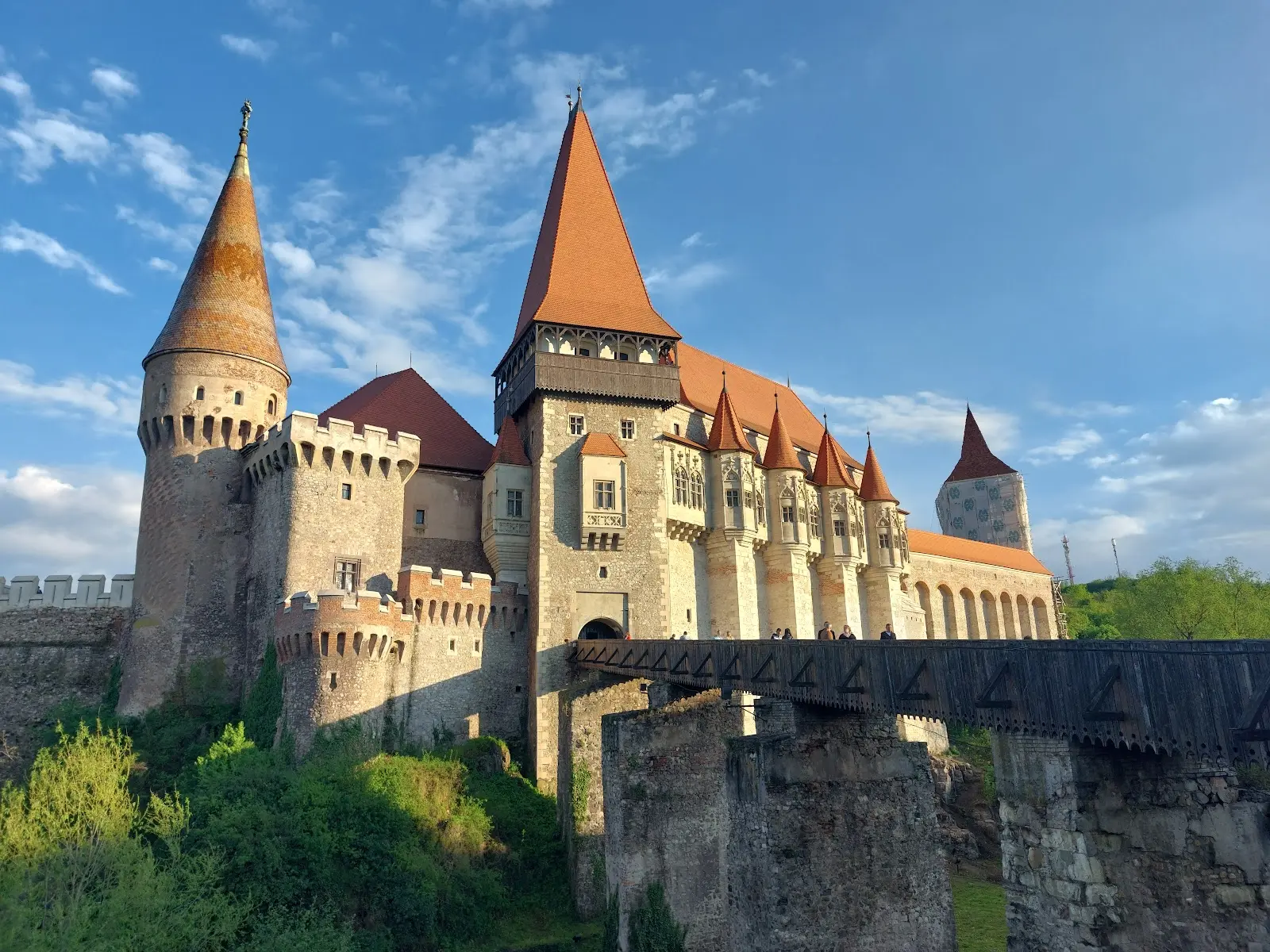
Few counties in Romania pack so much founding history into so little distance. In Hunedoara you can see, on one loop, a Gothic castle straight out of a legend, the Dacian capital hidden in the mountains, and the Roman capital that replaced it. Above it all, the Retezat raises the wildest alpine terrain in the country.
Why go
Hunedoara does not sell itself at first glance. The town that gives the county its name has an industrial silhouette, the mountain roads are sometimes rough, and the sights are scattered across different valleys. That is exactly the charm: you do not queue for photographs here, you find big things in quiet places.
For a visitor from abroad, Hunedoara is the best place in Romania to understand where everything came from. The layers stack up neatly: the Dacian kingdom with its capital in the mountains, the Roman conquest and the city it left behind, then Transylvanian medieval power expressed in a castle that belonged to the region's strongest family. All of it fits comfortably into two days of driving.
Corvin Castle, the centrepiece
Corvin Castle, also known as Hunyadi Castle, is one of the most spectacular Gothic castles in Europe and the reason most visitors come. You see it from far away: a block of stone with towers and steep roofs, set on a rock and joined to the town by a long bridge over the ravine. Its link to John Hunyadi (Iancu de Hunedoara) gives it its historical weight — this was the seat of the family that produced one of Transylvania's most important medieval figures.
The interior deserves time. The galleried courtyard, the great hall, the chapel, the narrow stone stairs and the towers form a circuit that takes at least an hour and a half, longer if you read the panels. Come early in the day or near closing: in the middle of the day, especially on summer weekends, the bridge and the courtyard get crowded.
The Dacian layer: Sarmizegetusa Regia
About an hour and a half east, hidden in the Orăștie Mountains, lies Sarmizegetusa Regia — the capital of pre-Roman Dacia and the country's most important archaeological site, part of the UNESCO World Heritage list. Do not expect high walls: what remains are the terraces cut into the slope, the paved road, the sacred precinct with its circular and rectangular temples, and the famous andesite disc. The power of the place is atmospheric — a forest clearing, deep quiet, and the unmistakable sense that you have reached the centre of a vanished world.
The access road runs through the Grădiștea gorges and turns into a forest track on the final stretch. Low-clearance cars struggle, and heavy rain can change conditions. Give it a solid half day including the drive, and set out in the morning. The site sits inside the Grădiștea Muncelului-Cioclovina Nature Park, so protected-area rules apply: stay on the paths, no metal detectors, nothing picked up off the ground.
The Roman layer: Ulpia Traiana Sarmizegetusa
After the conquest, the Romans built their provincial capital in the valley below the mountains, at Ulpia Traiana Sarmizegetusa — beside the village that still carries the name today. Borrowing the name was a political statement, and the ruins back it up: the forum, the amphitheatre, the temples and the city walls are still readable on the ground, across a broad, gentle site that feels very easy after the mountain road.
Pairing the two Sarmizegetusas, Dacian and Roman, is the experience that defines the county. If you have time for only one contrast, make it this one.
Stone churches and places of prayer
A few kilometres from the Roman ruins, Densuș Church is one of the oldest stone churches in Romania — and it is literally built from Roman material salvaged from Ulpia Traiana. Columns, blocks and inscribed stones were reused in a small, stocky building whose shape resembles nothing else. For how little space it occupies, it is one of the most memorable places in the country.
Further west, Prislop Monastery is one of Romania's best-known pilgrimage sites, set among forest and running water. If you arrive on a major pilgrimage day, expect traffic and long waits; the rest of the year it is a calm place.
The mountains: Retezat and Lake Bucura
The southern part of the county reaches into the Retezat, Romania's most celebrated alpine massif and home to the country's largest glacial lake, Lake Bucura. This is not a roadside stop: you get there on foot, with a serious hike, mountain gear and a checked forecast. For routes, stages and tent-or-hut logistics, our mountain portal, munte.online, is the right place — the Retezat is its territory.
Getting there and around
- By car: the A1 motorway passes Deva and Simeria, so access from Sibiu, Timișoara or Arad is straightforward. Deva to Hunedoara is only a short connecting drive.
- By train: Simeria and Deva are rail hubs on the main line across the country, and Hunedoara has its own branch. Trains get you to the castle, but not to the mountain sites.
- Locally: a car is effectively essential. The sights sit in different valleys — Hunedoara, Hațeg, Sarmizegetusa, the Orăștie Mountains — and public transport between them is rare and slow.
- Taxis and apps: they work in Deva and Hunedoara for town trips, not for day excursions into the mountains.
Best time to visit
May to October is the broad window in which every layer of the county is reachable. June and September are the most balanced: long days, dry roads, reasonable crowds. In July and August the castle fills up at midday, while the archaeological sites stay surprisingly quiet. Autumn gives the best light for photography and the Orăștie forests at their peak.
Winter changes the rules: the castle is atmospheric and empty, but the road to Sarmizegetusa Regia can be impassable, and Retezat trails become genuine winter mountaineering, which requires real experience.
A one or two day plan
Day 1 — the Middle Ages and the Romans. Morning at Corvin Castle, right at opening. In the afternoon drop down into the Hațeg basin for Ulpia Traiana Sarmizegetusa and Densuș Church, a few kilometres apart. If the light holds, Prislop Monastery closes the day.
Day 2 — the Dacians. A full day for Sarmizegetusa Regia, with an early start and the drive through the Grădiștea gorges. Alternatively, if you are equipped for the mountains, give the day to the Retezat.
For a detailed list of sights, see what to see in Hunedoara, and for choosing a base, where to stay in Hunedoara and around.
In short
- Non-negotiable: Corvin Castle, Sarmizegetusa Regia, Ulpia Traiana Sarmizegetusa, Densuș Church.
- Ideal length: two full days; three if you add the Retezat.
- Car: yes, essential for the mountain sites, with decent ground clearance for the forest track.
- Pack: sturdy shoes, a rain shell, water and some food — the archaeological sites have no services.
- Cash: useful in villages and at small access points, where card payment is not guaranteed.
- Site etiquette: do not climb on structures, do not take stones, do not leave the paths inside the protected area.
Plan your trip
Stays nearby
Stays in Romania
Experiences
Tours & activities
Guided tours, day trips and hand-picked experiences via GetYourGuide — free cancellation on most.
See all experiencesGetting to Romania
Flights, transfer & car
Fly into Romania
Compare fares to Bucharest Otopeni (OTP) and regional airports — Cluj, Sibiu, Iași, Timișoara.
Airport transfer
Private, fixed-price door-to-door transfer — driver waiting from the moment you land.
Rent a car — see the real Romania
A rental car is the key to Romania: the Transfăgărășan, the painted monasteries of Bucovina, mountain roads and the villages of Maramureș that no train reaches.
Find a car











