
What to see in Hunedoara: attractions & experiences
The sights that matter in Hunedoara county, from Corvin Castle and Sarmizegetusa Regia to Ulpia Traiana, Densuș Church, Bolii Cave and the Retezat, plus themed lists for one day, families and bad weather.
Hunedoara is not visited in one spot. Its sights sit in different valleys, half an hour to an hour and a half apart, and each belongs to a different layer of history. Here is what deserves your time, in the order that makes sense on a map.
Corvin Castle
Corvin Castle is the county's headline sight and one of the most spectacular Gothic buildings in Europe. Tied to the name of John Hunyadi (Iancu de Hunedoara), it rises on a rock above a ravine crossed by a long bridge — that first view, from the bridge, is the one you will remember.
The interior circuit runs through the galleried courtyard, the great hall, the chapel, the towers and narrow stone stairs. Allow at least an hour and a half. Come at opening or in the last part of the day; at midday in season, the bridge becomes a queue of people.
- Best photo angles: from the bridge and from the terrace above the river.
- The interior stays cool even in August — bring a light layer.
- Not an easy site for strollers: stairs, thresholds, uneven paving.
Sarmizegetusa Regia and the Orăștie Mountains
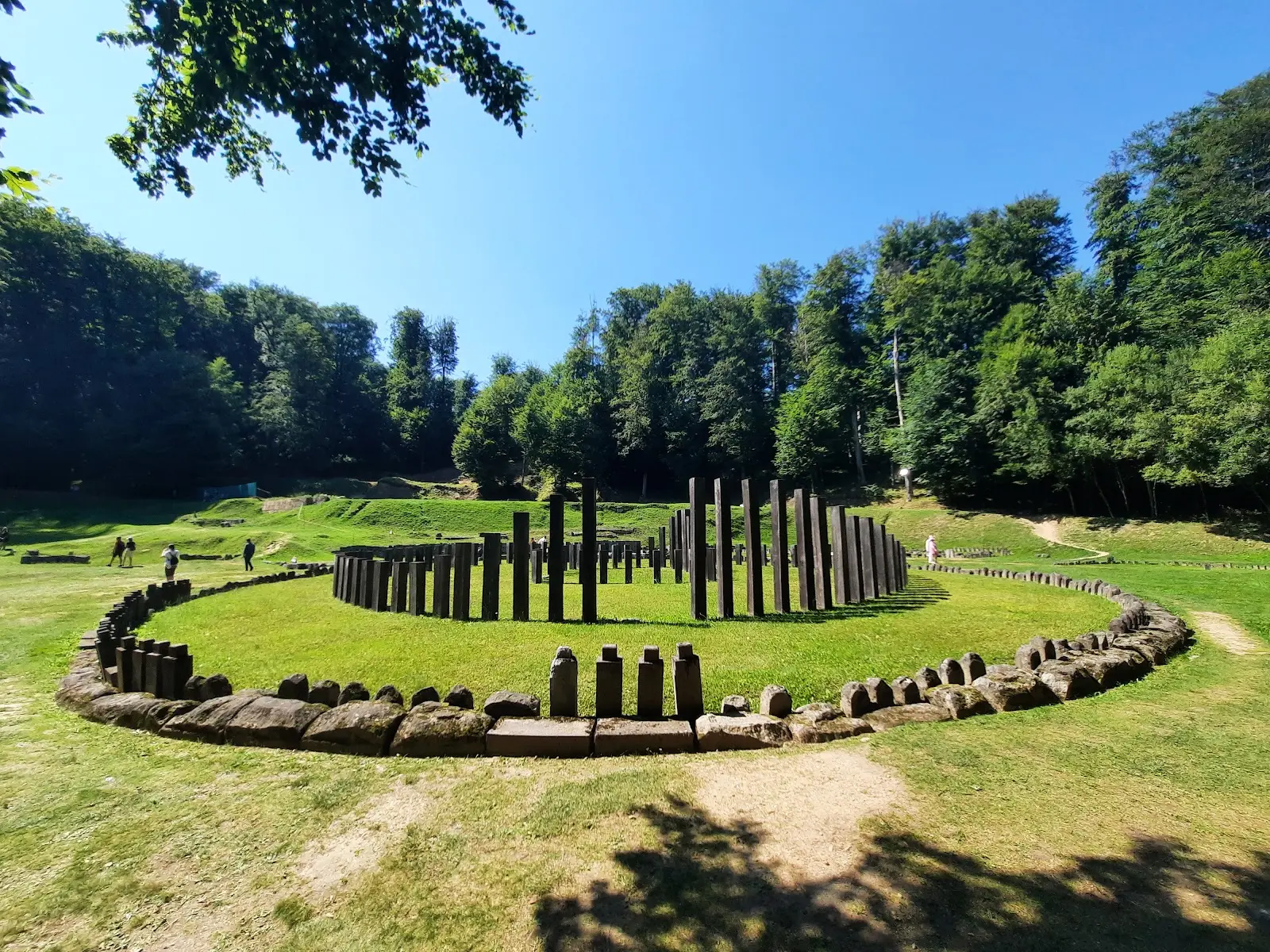
Sarmizegetusa Regia was the capital of pre-Roman Dacia and is part of the UNESCO World Heritage list. It has no towering walls: it has terraces cut into the slope, a paved road and a sacred precinct of circular and rectangular temples, including the famous andesite disc. The effect builds slowly as you climb through the forest and realise how large the settlement was.
The access road climbs through the Grădiștea gorges and turns into a forest track at the end. It is not for low-clearance cars, and long rain makes it worse. The site lies inside the Grădiștea Muncelului-Cioclovina Nature Park, so protected-area rules are firm: stay on the paths, no metal detectors, take nothing off the ground.
- Budget half a day, including the drive.
- Leave in the morning; afternoons bring mist and summer storms in these mountains.
- Wear shoes with real grip: the path is stony and slick when wet.
Ulpia Traiana Sarmizegetusa
After the Roman conquest, the provincial capital moved down into the valley, to Ulpia Traiana Sarmizegetusa. Taking the defeated enemy's name was a political decision, and the site is surprisingly generous: the forum, the amphitheatre, temples and traces of the city walls read clearly on the ground.
It is the ideal visit after coming down from the mountains — flat, orderly, easy to walk, and a history lesson that connects directly to what you saw up there. With children, there is room to move here, and the amphitheatre explains itself without a lecture.
- An hour is enough; two if you read everything.
- There is little shade — hat and water on summer days.
- The neighbouring village carries the same name, so double-check your destination in the GPS: the Sarmizegetusa in the valley is not Sarmizegetusa Regia in the mountains.
Densuș Church
A few kilometres from the Roman ruins, Densuș Church is one of the oldest stone churches in Romania. What makes it unique is the material: columns, blocks and inscribed stones salvaged from Ulpia Traiana, reused in a small, stocky building whose silhouette resembles no other church in the country.
It is a short stop, twenty or thirty minutes, but one of the most memorable in the whole county. Treat it with the respect due an active place of worship.
Prislop Monastery
Prislop Monastery is one of Romania's best-known pilgrimage sites, set among forest, streams and quiet. On ordinary days it is contemplative and good for a slow walk; on major pilgrimage days, access and parking become difficult and patience is required.
- Respect the dress code of a monastic site.
- Go in the morning if you want calm.
Bolii Cave
Bolii Cave is a water-carved cave with wide portals and a natural stage set that impresses immediately, close to the road between Petroșani and Hațeg. It is one of the most accessible underground attractions in the area and a good short stop between the bigger sights.
- Constant, cool temperature: bring a jacket even in summer.
- The rock is wet — grippy footwear, not sandals.
- A headlamp if you want to see more than the portals.
Deva and the cable car to the citadel
Deva is the gateway to the county and has a symbol of its own: a volcanic hill with a medieval citadel on top. The Deva cable car climbs almost to the ruins, and the panorama up there takes in the Mureș valley and, on a clear day, the southern ridges. It is an hour-and-a-half stop, perfect for a first or last evening.
- It is almost always windy up there — a light jacket makes the difference.
- From the upper station there is still a stretch to climb on foot to the ruins.
- Sunset from the hill is the best photograph in town.
Retezat and Lake Bucura
The south of the county reaches into the Retezat, the massif that holds Lake Bucura, the largest glacial lake in Romania. This is not a drive-up sight: you reach it on foot, on long trails, with mountain gear and a checked forecast. Without a full day and decent fitness, save it for a dedicated trip.
The drive between the sights
In Hunedoara, the driving is part of the experience. Between the castle, the Roman ruins and the villages of the Hațeg basin you follow wide valleys, with wooded hills on one side and high ridges on the other, through villages where stone houses and hay in the yard are not tourist decor. Distances look short on the map, but the local roads are narrow and winding, and an unplanned stop at a village with an old church is almost inevitable.
- Add ten or fifteen minutes to whatever your app promises for each local leg.
- Fill up in Deva, Hunedoara or Hațeg; in the villages, fuel stations are rare.
- In summer, livestock on the road is normal, especially early and late in the day.
If you only have one day
- Morning: Corvin Castle, right at opening.
- Afternoon: Ulpia Traiana Sarmizegetusa and Densuș Church.
- Evening: the Deva cable car, if the light holds.
For history lovers
- Sarmizegetusa Regia, with enough time for the sacred precinct.
- Ulpia Traiana Sarmizegetusa straight afterwards, for the Dacian-Roman contrast.
- Densuș Church, as physical proof of an empire being recycled.
With children
- Corvin Castle — courtyards, towers, stairs, the easiest one to love.
- Bolii Cave, short and dramatic.
- The Deva cable car, with the citadel at the top.
In bad weather
- The castle interiors.
- Bolii Cave, where the rain outside does not matter.
- Archaeological sites turn slippery and unpleasant — postpone them.
For the full context of the county, read the Hunedoara guide, and for the right base, where to stay in Hunedoara and around.
Plan your trip
Stays nearby
Stays in Romania
Experiences
Tours & activities
Guided tours, day trips and hand-picked experiences via GetYourGuide — free cancellation on most.
See all experiencesGetting to Romania
Flights, transfer & car
Fly into Romania
Compare fares to Bucharest Otopeni (OTP) and regional airports — Cluj, Sibiu, Iași, Timișoara.
Airport transfer
Private, fixed-price door-to-door transfer — driver waiting from the moment you land.
Rent a car — see the real Romania
A rental car is the key to Romania: the Transfăgărășan, the painted monasteries of Bucovina, mountain roads and the villages of Maramureș that no train reaches.
Find a car











