The Complete Guide to Constanța
Romania's oldest continuously inhabited city, founded by the Greeks as Tomis nearly 2,600 years ago. A complete guide to the Black Sea port: the seafront and its Art Nouveau Casino, the old peninsula, the museums and the day trips across Dobrogea.
Few cities in Europe can count their years in millennia without breaking the thread. Constanța can: founded by Greek colonists as Tomis around the 6th century BC, it has been inhabited ever since, which makes it Romania's oldest city. It was here that the Latin poet Ovid was exiled, writing his final verses looking out over the same sea you still see today from the seafront.
Why Constanța
Constanța is not a resort but a living port city with almost 2,600 years of history underfoot. The layers overlap: Greek foundations, Roman walls, Ottoman mosques, interwar boulevards and shipyard cranes. It is the largest city on the Romanian coast and the country's main gateway to the Black Sea.
- Romania's oldest continuously inhabited city
- Place of exile of the poet Ovid, who died here around AD 17
- The country's most important maritime port, on the Black Sea
- An ideal base for the rest of the coast and for Dobrogea
The seafront and the Casino
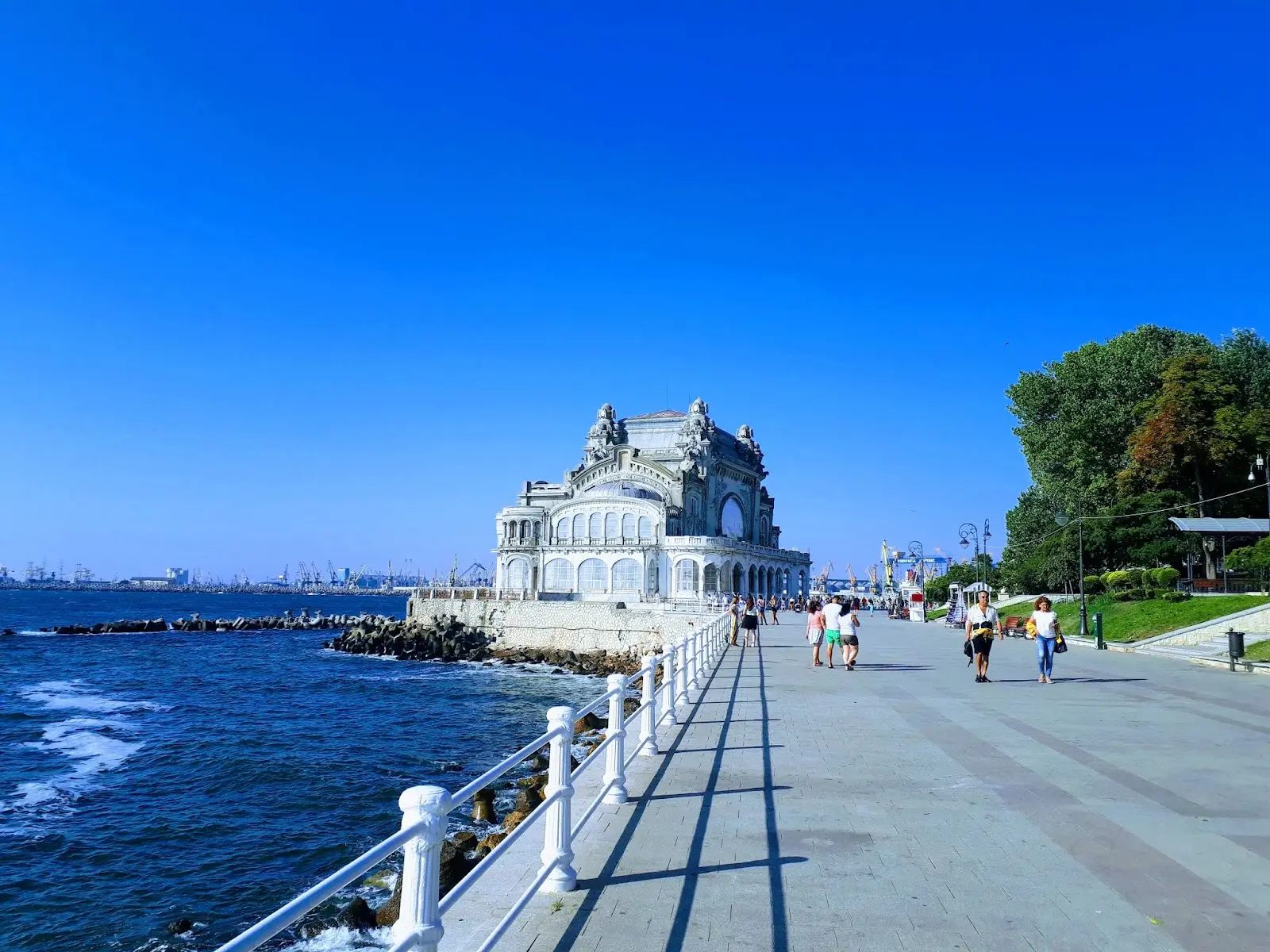
The symbolic heart of the city is the seafront that wraps around the old peninsula, and its absolute landmark is the Constanța Casino. Built in the early 20th century in the Art Nouveau style, its lace-like façade turned toward the waves, it was for decades the promenade of the elite. After a long period of decay, the building has been restored and reopened to the public, once again the most photographed monument on the coast.
A walk along the seafront, especially toward sunset, is the best introduction to the city: the sea on one side, the old town on the other.
The old peninsula
The old town, narrow and gathered on the peninsula, is best explored on foot. Its landmarks stand only minutes apart.
- Ovidiu Square and the statue of the poet, in front of the National History and Archaeology Museum
- The Roman Mosaic Edifice, a vast ancient commercial complex whose decorated floors can be seen sheltered and protected
- The Genoese Lighthouse, a reminder of the merchants who once linked the Black Sea to the Mediterranean
- The Great Mosque (Carol I / Mahmudiye), whose minaret, if you climb it, opens a wide panorama over the port
The surrounding lanes, lined with interwar houses in varying states of restoration, give the area a melancholy, authentic feel very different from the crowds of the resorts.
Museums and aquarium
For historical context, the National History and Archaeology Museum on Ovidiu Square holds remarkable ancient pieces unearthed from Tomis and Dobrogea. Not far away, on the seafront, the Aquarium remains a classic stop, especially for those traveling with children.
- National History and Archaeology Museum — Greco-Roman and Dobrogean collections
- The seafront Aquarium — Black Sea fauna and exotic species
- The Romanian Navy Museum — for lovers of naval history
The port and the marina
Constanța lives from the sea. The Port of Constanța is the largest on the Black Sea and one of the most important in the region, and its skyline of cranes and cargo ships is part of the city's identity. Beside it, Tomis Port, with its marina of pleasure craft, offers a more relaxed face: terraces, masts and short boat trips. The contrast between the industrial port and the pleasure marina tells, in a few hundred meters, the whole story of the city.
The surrounding coast
Constanța is also the best starting point for the rest of the coast. Right next to the city, to the north, stretches Mamaia, the coast's best-known resort, with its wide beach and holiday life. To the south, the string of resorts continues:
- Eforie Nord and Eforie Sud, with beaches and spa treatments beside Lake Techirghiol
- Neptun, Olimp and Jupiter, the coast's classic resorts
- Vama Veche, the village on the Bulgarian border famous for its free, bohemian atmosphere
If you want a quick contrast between a historic city and a beach, Mamaia is minutes away; for a slower day, head down to the southern resorts.
Day trips into Dobrogea
Beyond the beach, the Dobrogean hinterland hides some of Romania's most interesting sites. It is worth a full day.
- Histria, the oldest fortress on Romanian soil, also founded by the Greeks, with sprawling ruins beside a lagoon
- The Danube–Black Sea Canal, the great hydraulic work linking the river to the port
- Adamclisi, with the Roman monument Tropaeum Traiani, raised to mark the victories over the Dacians
These places complete the portrait of a region where Greeks, Romans, Ottomans and Romanians each left their mark in turn.
Practical — when, how long, how
Constanța is, above all, a summer city: the coast comes alive from June to September, with July and August at the peak of the season. Late spring and early autumn are ideal if you want the old town and the museums without the crowds, in still-mild weather.
- When: summer for the beach; May–June and September for the city, with fewer people
- How long: two days for the city and seafront; add one or two more for the coast and Dobrogea
- How to get there: Constanța is linked to Bucharest by motorway and railway, a few hours from the capital, and has its own airport
Whether you come for the stones of Tomis, for the façade of the Casino, or simply for the salt smell of the port, Constanța rewards the traveler who takes the time to look beyond the beach.
Plan your trip
Stays nearby
Stays in Romania
Experiences
Tours & activities
Guided tours, day trips and hand-picked experiences via GetYourGuide — free cancellation on most.
See all experiencesGetting to Romania
Flights, transfer & car
Fly into Romania
Compare fares to Bucharest Otopeni (OTP) and regional airports — Cluj, Sibiu, Iași, Timișoara.
Airport transfer
Private, fixed-price door-to-door transfer — driver waiting from the moment you land.
Rent a car — see the real Romania
A rental car is the key to Romania: the Transfăgărășan, the painted monasteries of Bucovina, mountain roads and the villages of Maramureș that no train reaches.
Find a car