
Complete guide to Botoșani
A modest town in northern Moldavia with a half-restored historic centre — but the land where Eminescu, Enescu and Iorga were born. An honest guide to what genuinely deserves a stop.
Botoșani is a town few travelers put on a list, which is exactly why it deserves an honest look. It has no citadel, no mountains and no photogenic restored old town. What it does have is something no other part of Romania can claim: within a few kilometres of farmland, three of the greatest names in Romanian culture were born.
Why come
Botoșani is a town in northern Moldavia, set on a plateau of gentle hills, well away from the main tourist routes. For centuries it was an important commercial centre of Moldavia — a merchants' market town, with sizeable Armenian and Jewish communities that left behind shopfronts, two-storey houses and churches. That historic centre still exists, but it is a restoration in progress: on some streets the work is finished and you can see how the town looked a century and a half ago, on others the facades are still waiting. Come expecting a work in progress, not a finished stage set.
The real value of the place, though, is not in the town itself. It is in the countryside around it. Mihai Eminescu, Romania's national poet, was born at Ipotești, a few kilometres from Botoșani, where a memorial now stands. George Enescu, the composer, was born at Liveni, in the south of the county. Nicolae Iorga, the historian, was born in Botoșani. No other Romanian county gathers such names so tightly together, and the circuit of these houses is, quite rightly, the main reason you would come here.
What to see in town
The town itself can be covered in half a day, without rushing.
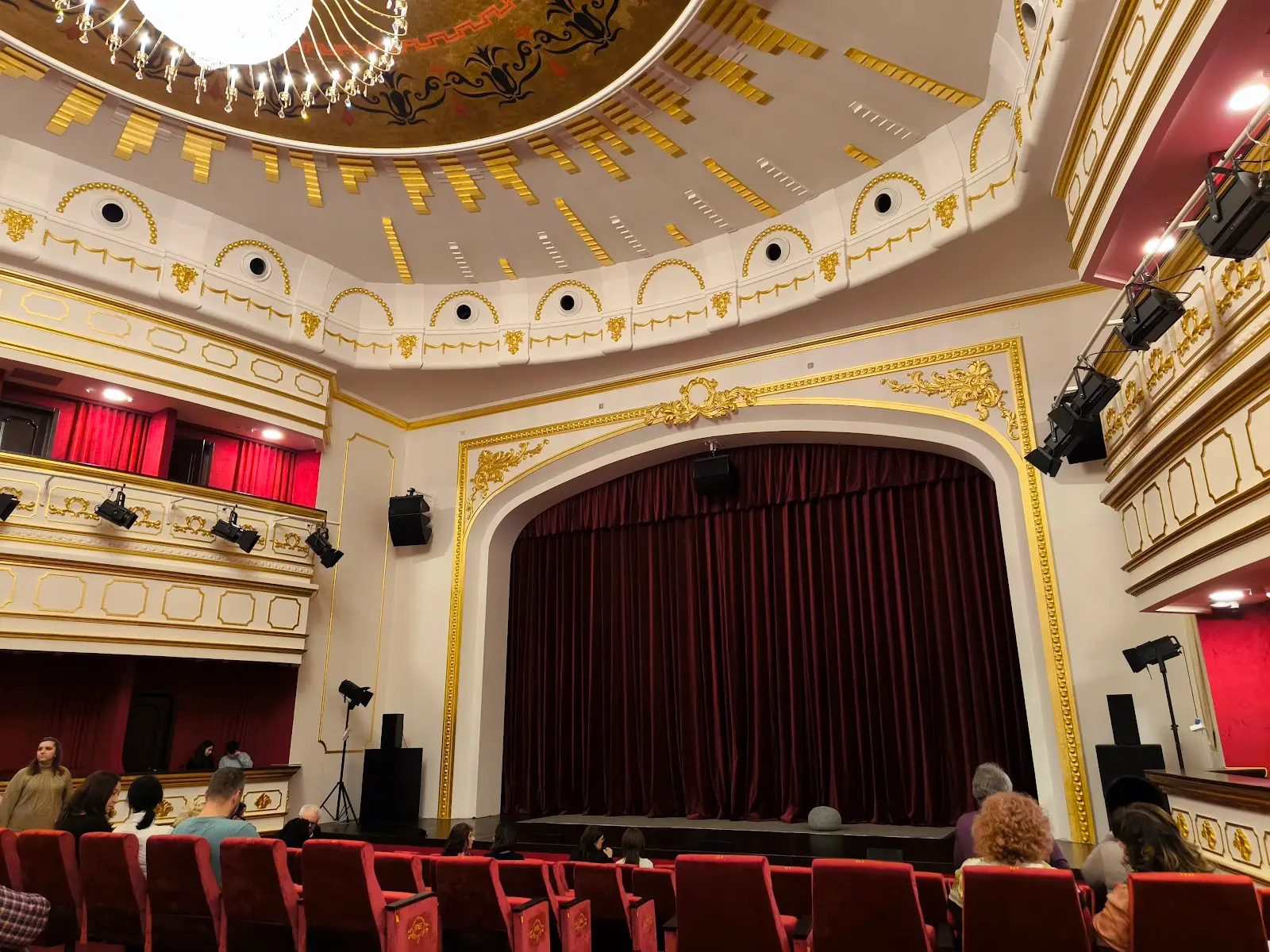
- The Mihai Eminescu Theatre — the town's playhouse and the finest piece of urban architecture in Botoșani. Worth seeing from the outside for the building alone, but if you can catch a performance, it is the best evening available here.
- The historic centre — the old commercial street, with 19th-century shopfronts. A walk of a few dozen minutes.
- Uspenia Church — the church where Eminescu was baptised. Small and unassuming, but tied directly into the memorial circuit.
- St Nicholas Popăuți Church — founded by Ștefan cel Mare, one of the town's medieval churches and its oldest monument.
- The Nicolae Iorga memorial house — for anyone interested in Romanian historiography.
Beyond these points, Botoșani is an ordinary county seat, with apartment blocks, a market and traffic. Do not schedule more time for it than it warrants.
The memorial circuit — the real reason to come
This is where everything happens. Two stops, both outside the town, both essential.
Ipotești, a few kilometres from Botoșani, is where Eminescu spent his childhood. The memorial there brings together the house, the family church, the lake and the woods that return obsessively in his poetry. For anyone who read Eminescu at school, it changes the reading — the landscape in the verses is right there in front of you.
The George Enescu Memorial House at Liveni, in the south of the county, is the house where the composer was born. The drive there crosses plain villages with nothing spectacular along the way — but the house itself, modest and well kept, says more about Enescu's origins than any concert hall.
The two can be linked in a single day by car. Together, they fully justify the trip to Botoșani.
Monasteries in the area
The county has several old, little-visited monasteries that round out the day nicely:
- Vorona Monastery, in the forest south of town.
- Agafton Monastery, close to Botoșani and also connected to Eminescu's biography.
- Coșula Monastery, a 16th-century foundation and architecturally the most interesting in the county.
These are quiet places, with no coaches and no queues — the exact opposite of the famous painted monasteries of Bukovina.
Getting around and how long to stay
A car is effectively essential. Ipotești, Liveni and the monasteries are scattered across villages, and public transport links them only rarely. County roads are generally acceptable, but allow extra time.
Botoșani pairs naturally with our guide to Suceava and Bukovina — the painted monasteries are around two hours away — and with the guide to Iași, Moldavia's cultural capital, roughly two hours to the south. The best use of Botoșani is as a one-day stop between the two.
Practical notes
- How many days — one is enough: the town in the morning, Ipotești and Liveni in the afternoon. Two days only if you also want the monasteries.
- When to come — spring and autumn, when the hill landscape is at its best and the country roads are dry.
- Where to stay — in town, for simplicity. The choice is modest but adequate for a night.
- Who it suits — anyone interested in Romanian culture and literature. If you are coming to Romania for castles, mountains or the sea, Botoșani is not for you, and it is only fair to say so.
Botoșani makes no attempt to win you over. What it offers instead is rare: the physical place where several of the most important lives in Romanian culture began. For someone who knows why they came, that is enough.
Plan your trip
Stays nearby
Stays in Romania
Experiences
Tours & activities
Guided tours, day trips and hand-picked experiences via GetYourGuide — free cancellation on most.
See all experiencesGetting to Romania
Flights, transfer & car
Fly into Romania
Compare fares to Bucharest Otopeni (OTP) and regional airports — Cluj, Sibiu, Iași, Timișoara.
Airport transfer
Private, fixed-price door-to-door transfer — driver waiting from the moment you land.
Rent a car — see the real Romania
A rental car is the key to Romania: the Transfăgărășan, the painted monasteries of Bucovina, mountain roads and the villages of Maramureș that no train reaches.
Find a car











