
What to see in Vatra Dornei and around
The Baths Casino, the park with its mineral springs and the chairlift are all walkable from the resort centre, while Pietrele Doamnei in the Rarău mountains, the Călimani massif and the Poiana Stampei bog — Romania's largest — make easy day trips. The full list, with practical advice.
Vatra Dornei has a rare advantage for a mountain resort: half of its sights are walkable from the centre, and the other half are day trips through some of Bucovina's finest landscapes. Below is the real list, in the order that makes sense — from the park with its mineral springs to Pietrele Doamnei and Romania's largest peat bog.
The Baths Casino
The Baths Casino is the building on every photograph of the resort: a monumental structure raised in the early twentieth century in an eclectic style with secession accents, built for the society that came to take the waters. Even outside the periods when you can go inside, it rewards a close look — the façade detailing, the rhythm of the windows and the sheer scale say plainly how important this town once was.
The building is undergoing restoration and the stage of that work has shifted over time, so plan it as an exterior sight and ask locally whether the interior can be visited when you are there. The best light comes early in the morning and towards sunset, from the alleys of the park.
The resort park and the mineral springs
The park is the heart of the resort and the one sight you will see repeatedly without planning to. This is where the mineral springs are, along with alleys shaded by mature trees, the evening promenade and the best angles on the Casino.
- Go in the morning, when mist climbs off the river and the park is almost empty.
- Come back in the evening, for the promenade and the warm light on the period buildings.
- Ask locally which springs are set up for drinking cures and how they are used; the arrangements change over time.
The chairlift and the view from the top
The chairlift climbs straight out of the resort and is the easiest way to gain altitude without effort. At the top a broad panorama opens over the Dorna basin and the ridges that enclose it — the Călimani on one side, Rarău and Giumalău on the other.
In winter it is the lift that serves the skiing. In the warm season it becomes a starting point for walks on the plateau and for descents on foot, through pasture and forest, back into town. Check the operating schedule before you set off: mountain lifts run on seasonal hours and the weather has a vote.
The Dealu Negru slope
The Dealu Negru slope is why Vatra Dornei features in any serious discussion of Romanian skiing: it has a large vertical drop on a well-exposed flank, directly above the town. Having the start a few minutes from the centre changes the logistics of a winter stay completely — you can ski without a car, and still have the afternoon for a spa procedure or a coffee in the park.
For comparison with the country's other ski areas, see Romania's ski resorts.
Pietrele Doamnei and the Rarău mountains
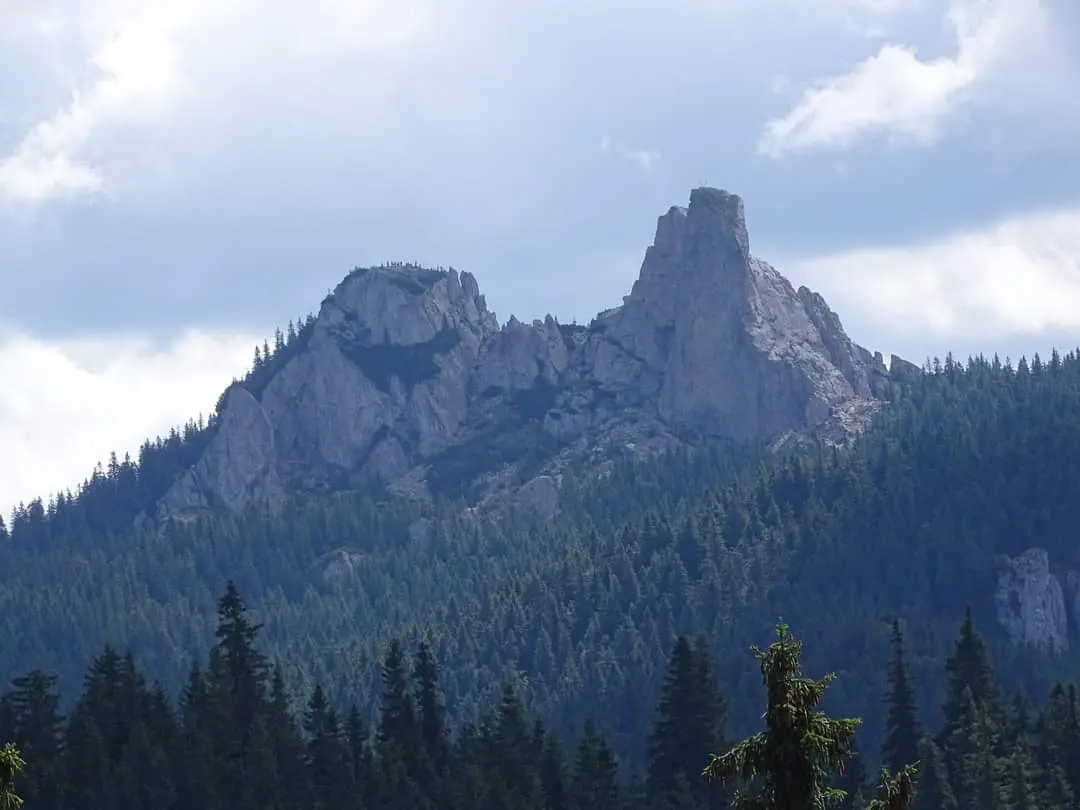
Pietrele Doamnei in the Rarău massif are probably Bucovina's best-known mountain image: limestone formations that rise abruptly out of spruce forest, visible from far off, with paths that skirt and climb them. This is the excursion almost everyone staying more than two days makes — and it earns its reputation.
A few things to know:
- The area is visited on marked trails; the rocky sections call for good footwear and care when wet.
- Mountain weather turns fast, August included — take an extra layer and a rain shell.
- Rarău is often linked with Giumalău in a longer ridge traverse, for those in shape for it.
For trails, walking times and current mountain conditions, the right resource in our network is munte.online.
The Poiana Stampei peat bog
The Poiana Stampei bog is the largest peat bog in Romania, protected as a nature reserve — and the strangest landscape anywhere nearby. It resembles nothing else around: dwarf pines, a carpet of sphagnum moss, plants adapted to poor acidic ground, all of it inherited from glacial times.
The visit follows the marked path, and there is one rule, absolute: do not step off the trail. Peat grows by millimetres a year and recovers over centuries; every sideways step destroys exactly what you came to see. It is a short stop, ideal to combine with the drive to or from Transylvania.
The Călimani mountains
To the south rise the Călimani, Romania's largest volcanic massif, protected as a national park. The landscape is nothing like Rarău's limestone: wide plateaus, dwarf pine, rock formations that were once the rim of a crater. The trails are long and exposed, with few water sources, so these are hikes you prepare for — not afternoon improvisations.
Giumalău and the spruce forests
Giumalău is the quiet option: a massif covered in old spruce forest, with long trails through the trees and clearings that open towards the ridges. You come here for the silence and the forest rather than for a view around every corner — and on a busy weekend, that is precisely its merit.
A day for the Bucovina beyond the mountains
Vatra Dornei is also a bridgehead for the rest of Bucovina. Eastwards the road descends through Câmpulung Moldovenesc towards the villages of the Moldova and Moldovița valleys and the painted monasteries listed as UNESCO World Heritage. It is a full day with a lot of driving, but the landscape and the churches justify it.
If you would rather not spend a whole day behind the wheel, stop at Câmpulung Moldovenesc alone: it is the town halfway along, the classic base for Rarău, with small museums and a centre you can cover in an afternoon. On the way, the valley villages deserve a slower pace — timber houses, carved gates, farmsteads with hay stacked in tall ricks. None of it comes with a ticket, and it is much of the reason Bucovina stays with you.
What to do if it rains
Mountain weather does not negotiate, and in the Dorna basin it can rain two days straight even in July. What works regardless:
- Spa procedures — mofettes, baths, drinking cures; the bad days are exactly when a treatment schedule proves its worth.
- A walk through the park and past the Casino, rain shell on: mist flatters period architecture.
- The peat bog, on its marked path — the bog arguably looks better in wet weather, as long as your footwear agrees.
- The drive to Câmpulung Moldovenesc and the monasteries — a day of interiors and tarmac rather than ridgelines.
How to split two or three days
- Day 1: the Casino and the park with its springs, then the chairlift for the panorama; an evening walk in the centre.
- Day 2: Rarău and Pietrele Doamnei, with a stop in Câmpulung Moldovenesc on the way back.
- Day 3: the Poiana Stampei bog in the morning, the afternoon free for a spa procedure or an easy walk along the valley.
The full context of the resort is in our Vatra Dornei guide, and for choosing your neighbourhood see where to stay in Vatra Dornei.
Plan your trip
Stays nearby
Stays in Romania
Experiences
Tours & activities
Guided tours, day trips and hand-picked experiences via GetYourGuide — free cancellation on most.
See all experiencesGetting to Romania
Flights, transfer & car
Fly into Romania
Compare fares to Bucharest Otopeni (OTP) and regional airports — Cluj, Sibiu, Iași, Timișoara.
Airport transfer
Private, fixed-price door-to-door transfer — driver waiting from the moment you land.
Rent a car — see the real Romania
A rental car is the key to Romania: the Transfăgărășan, the painted monasteries of Bucovina, mountain roads and the villages of Maramureș that no train reaches.
Find a car












