
What to see in Slănic-Moldova
The route that actually works in Slănic-Moldova: the Central Park with its mineral springs, the nineteenth-century casino, the Slănic waterfall in the beech forest and the Nemira ridges above the resort.
Slănic-Moldova is seen on foot, in a single day, without a complicated plan. All the main sights sit on the same valley, minutes apart, and the only real decision is the order you take them in. Below is the route that works best on the ground — from the springs and the casino to the waterfall in the forest.
1. The Central Park and the mineral springs
Start where the resort starts. The Central Park is Slănic's classic spa park: shaded avenues, benches, mature trees and, most importantly, the mineral springs captured in cure pavilions.
In the morning the park has its own rhythm: people come down from the hotels with a cup in hand, drink from the spring, do a lap of the paths, stop in the shade. It is not a spectacle, it is a routine more than a century old — and that is exactly what makes it interesting.
- Come in the morning, when the springs are the resort's gathering point.
- Walk the full circuit of the paths, not just the straight line from hotel to pavilion.
- Do not drink mineral water at random: each spring has its own indications, and the cure is taken under medical advice.
2. The casino, the building in every photograph
From the park paths you can see the Slănic-Moldova Casino, the resort's landmark building and the reference point by which you recognise the place in any period image.
Built while Slănic-Moldova was taking shape as a nineteenth-century resort, the casino was conceived as a social space — the room where the cure-taking crowd gathered in the evening, after the day's procedures. Today you look at it first as architecture: generous volumes, period detailing and a scale that is surprising for such a narrow valley.
- Look at it from the front, from the avenue, and then from the park — it offers two completely different images.
- The good light comes late in the morning and before sunset.
- Walk a little way around it to see how much of the valley it takes up.
3. Period architecture along the avenues
Between the park and the casino, it is worth walking with your head up. Slănic-Moldova was developed as a resort back in the nineteenth century, following the logic of Central European cure towns, and the traces of that era are still visible along the valley: cure buildings, hotels with verandas, pavilions and paths laid out for slow walking rather than traffic.
This is not a compact historic centre with streets and small squares, and it should not be mistaken for one. It is an ensemble spread along a single valley, where period buildings alternate with far newer construction. That very mixture tells the resort's real story: a reputation earned in the nineteenth century, with waters awarded prizes at international exhibitions, overlaid by every decade of intervention since.
- Walk the paths between the hotels and the park rather than the main road — that is where the resort's old scale survives.
- Look for the details: verandas, timberwork, facade ornament, spring pavilions.
- Look at the slopes too: beech forest comes down to the edge of the resort, and that is not an accident of planning — it is the landscape that drew people here in the first place.
4. The Slănic waterfall and the beech forest walk
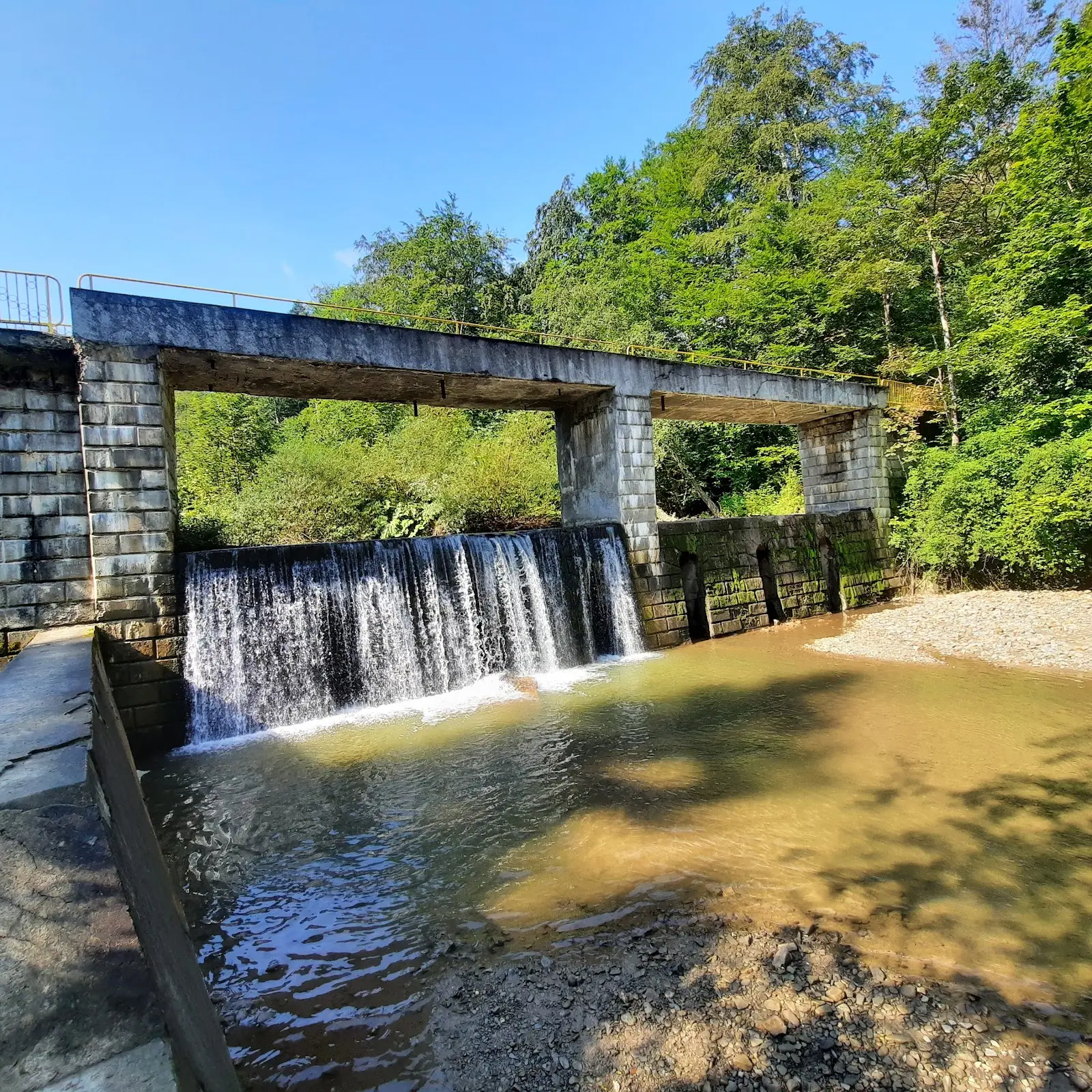
Once you are done with the avenues, head up along the stream towards the Slănic Waterfall. It is not a waterfall that impresses by size, and it does not need to be: its value is the walk to it, through dense, cool beech forest with the water alongside the whole way.
This is the walk almost anyone can do, including after a morning of treatments, and the best reason in the resort to get out from between the buildings.
- Shoes with decent grip — this is a forest path, not a park avenue.
- It looks best after rain and in early spring, when the water is high.
- In autumn, the forest around it becomes the main reason for the walk.
5. The Nemira Mountains, if you want more
The Nemira Mountains rise directly above the resort, and trails climb from Slănic-Moldova towards rounded ridges and wide clearings. It is a quiet massif, far from Bucegi traffic, but for exactly that reason it is not improvised: you need a map, proper gear and an honest count of daylight hours. For routes and conditions, our mountain resource is munte.online.
6. The valley, the air and the evening walk
The last thing to see in Slănic-Moldova is not a sight at all. The resort sits in an enclosed valley with damp, cool air even in August, and the evening stroll along the paths between the hotels and the park is part of the reason people have been coming back here for generations.
- Go out after dinner, when the valley cools sharply and falls completely quiet.
- Bring a jumper even in summer — the nights are cold.
- Do not look for an evening programme; there is none, and that is the point.
How to split your time
- One day — the park and the springs in the morning, the casino at midday, the waterfall in the afternoon. Enough for everything there is to see.
- A weekend — add a morning of hiking towards the Nemira and an afternoon with no plan at all.
- A week — only if you are here for a cure, with procedures and a treatment schedule. Then the valley becomes enough.
Be realistic about Slănic-Moldova
The resort is quiet and suited to treatment and walking, not to nightlife. The list of sights is short and exhausts itself in a day; the real value is in the air, the water and the slow rhythm, not in the number of places ticked off. Come expecting buzz and you will be disappointed. Come for three days of forest, springs and silence and Slănic-Moldova delivers exactly what it promises — which is why people still call it the Pearl of Moldavia.
For the full context — how to get there, how the cure works, when it is best to go — read our complete guide to Slănic-Moldova.
Plan your trip
Stays nearby
Stays in Romania
Experiences
Tours & activities
Guided tours, day trips and hand-picked experiences via GetYourGuide — free cancellation on most.
See all experiencesGetting to Romania
Flights, transfer & car
Fly into Romania
Compare fares to Bucharest Otopeni (OTP) and regional airports — Cluj, Sibiu, Iași, Timișoara.
Airport transfer
Private, fixed-price door-to-door transfer — driver waiting from the moment you land.
Rent a car — see the real Romania
A rental car is the key to Romania: the Transfăgărășan, the painted monasteries of Bucovina, mountain roads and the villages of Maramureș that no train reaches.
Find a car











