
What to see in Odorheiu Secuiesc and around
The Székely Fortress, the Haáz Rezső Museum and the Reformed Church in town; Szejke Baths and Orbán Balázs's grave on the edge; the UNESCO-listed fortified Unitarian church of Dârjiu and the carved gates of the surrounding villages. The full list, ordered for a weekend.
Odorheiu Secuiesc has exactly the right number of sights: enough to fill a weekend, few enough that you never have to rush. The town itself is a day on foot, and the surroundings — mineral springs, villages of carved gates and a World Heritage fortified church — take the second day. Below, the list in the order that actually makes sense.
The Székely Fortress
The Székely Fortress, known locally in Romanian as Cetatea Șișului, is the town's emblem: a sixteenth-century Renaissance fortification sitting at the edge of the centre.
This is an artillery fortress, not a storybook one: thick low walls, bastion corners, geometry calculated to deflect cannonballs. If you are used to castles with pointed towers, the first impression can read as austere — until you realise that the austerity is engineering, not a lack of ambition.
- How long: a comfortable hour, longer if you catch an exhibition.
- How to see it well: walk the full exterior circuit. The entrance façade is the least interesting view; the flanks show the structure.
- When: early morning, for quiet and side light.
The Haáz Rezső Museum
The Haáz Rezső Museum is the town museum, with collections of ethnography and local history. For a visitor it is the most efficient use of time in the whole town.
The reason is simple: without it, the rest of the region stays picturesque but mute. With it, the carved gates, the tools, the costumes and the social organisation of the Székely Land acquire an explanation. Put it at the start of your visit, not at the end.
- How long: one to two hours, depending on how much you read.
- Good for: families with older children, travellers who want context, rainy days.
The Reformed Church and the walk between denominations
The Reformed Church is one of the landmark buildings of the centre: clean, austere space built for the sermon and the congregation, squarely in the tradition of the Transylvanian reformation.
But the real sight is not a single church — it is the route between them. Reformed, Catholic, Unitarian and Orthodox buildings stand minutes apart, and that short walk is the best lesson in local history you can get without a guide.
- How long: 45 minutes to an hour for the whole circuit.
- Remember: these are working churches. Enter discreetly, respect services, ask before photographing inside.
The old centre, on foot
Odorheiu's centre is compact and likeable: squares, terraced nineteenth- and twentieth-century houses, inner courtyards, terraces, bilingual shopfronts. No single monument dominates; the value is in the ensemble and the pace.
- Do this: a coffee on a central terrace, then an hour of walking with no destination.
- Look for: façade details, old gates, bilingual inscriptions, small workshops.
Szejke Baths and Orbán Balázs's grave
Szejke Baths, on the edge of town, is an area of mineral waters with the atmosphere of a small, very local spa resort. You don't come for luxury — you come for the springs, the hill air and the context.
Because this is also where Orbán Balázs is buried — the man called the greatest Székely, the nineteenth-century ethnographer who described the Székely Land village by village and gave the region its written portrait. The combination of springs and cultural memory makes Szejke the best afternoon in the area.
- How long: half a day, with a walk and a stop at a terrace.
- Good for: couples, families, days when you want a slow rhythm.
Dârjiu: the fortified Unitarian church, UNESCO World Heritage
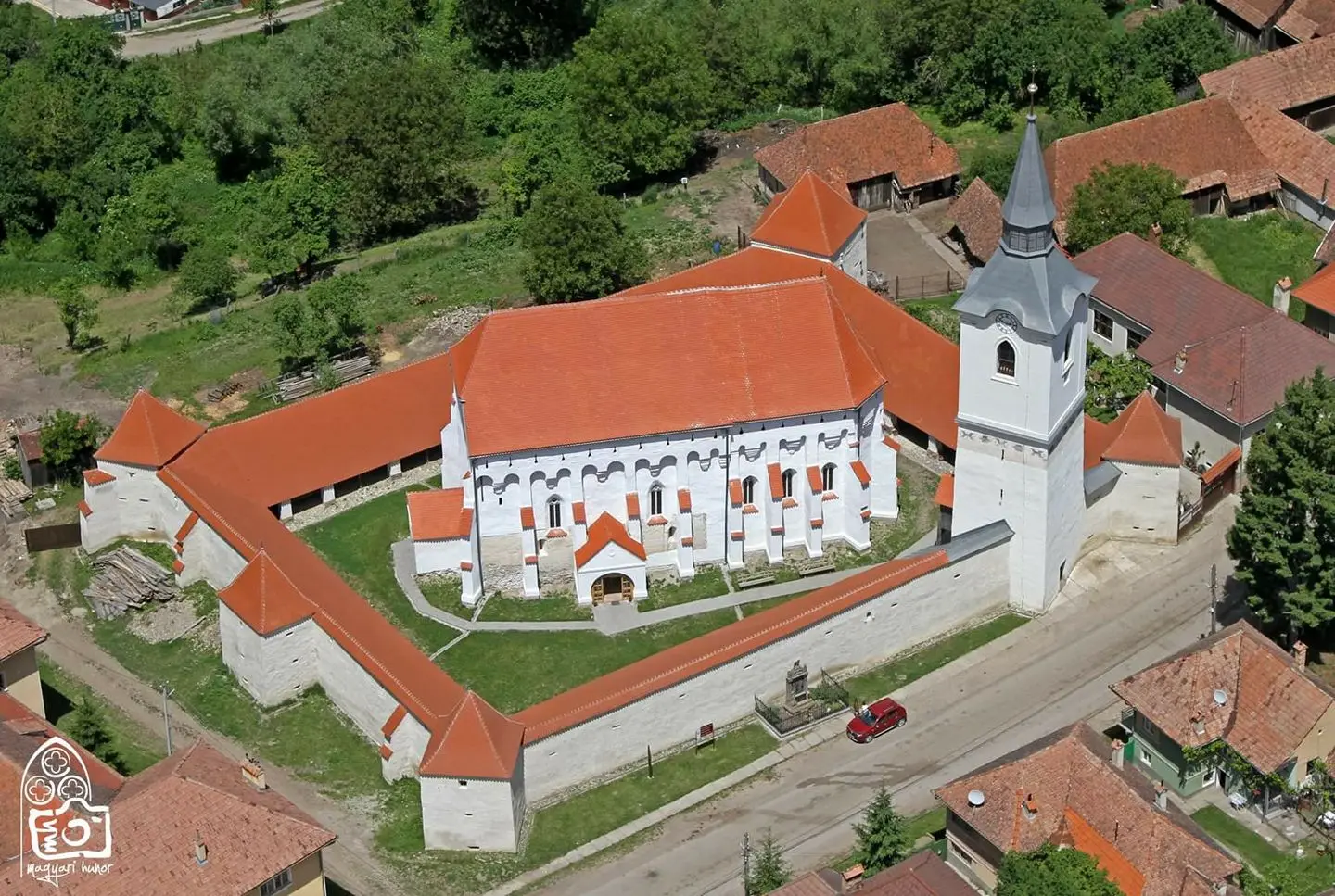
The most valuable sight in the surroundings is at Dârjiu: a fortified Unitarian church inscribed on the UNESCO World Heritage list as part of the group of villages with fortified churches in Transylvania. It is remarkable for the medieval frescoes preserved inside — old painting, in a small village, with no queue at the door.
The combination is unique: peasant fortification, Unitarian congregation and medieval painting in one place. See the page on the church at Dârjiu for details, and for Romania's other World Heritage sites, our UNESCO guide.
- How long: two to three hours including the drive, longer if you stop in the villages.
- Important: this is a village church, not a museum with mall hours. Ask about access before setting off, and be prepared to look for whoever holds the key.
- Without a car: taxi, transfer or an organised trip. Public transport to the small villages is sparse.
The Székely gates of the surrounding villages
The region is known for its carved Székely gates: large wooden gateways with their own roof and a separate pedestrian arch, covered in carved motifs. No ticket, no opening hours, no museum — they are on people's houses.
Which is why the best way to see them is a slow drive on secondary roads with short stops. If you have already been to the town museum, you will recognise the motifs and understand what they say.
- Do this: a half-day loop through the villages around town.
- Etiquette: photograph from the road, not from the yard. If the owner comes out, say hello — a story usually follows.
The hills and the roads around
Odorheiu sits in a landscape of wooded hills, with roads climbing to pastures and clearings. This is not mountaineering and you need no serious kit: these are walks of a few hours, with wide views and villages in the valley below.
The best half-day version is to climb a pasture track to a point above town and come back down a different slope. You will see how Odorheiu sits in its relief — a town set in a hollow, with villages rising all around it — and understand why the roads here lead naturally towards neighbours rather than into isolation. Take water, a light jacket and shoes that cope with wet grass; hill weather turns quickly.
- Spring and autumn are the best windows: colour, clear air, fewer insects and less heat.
- In winter the back roads demand caution — the town carries on, but the hills do not forgive improvisation.
Putting it together in a weekend
- Saturday: the Haáz Rezső Museum in the morning, the Székely Fortress before lunch, the church circuit including the Reformed Church plus a stroll through the centre in the afternoon.
- Sunday: Dârjiu in the morning while the light is good on the frescoes, then back through the villages for the gates, finishing at Szejke Baths.
For the full context of the town see the complete guide to Odorheiu Secuiesc; for accommodation areas, where to stay in Odorheiu Secuiesc.
Plan your trip
Stays nearby
Stays in Romania
Experiences
Tours & activities
Guided tours, day trips and hand-picked experiences via GetYourGuide — free cancellation on most.
See all experiencesGetting to Romania
Flights, transfer & car
Fly into Romania
Compare fares to Bucharest Otopeni (OTP) and regional airports — Cluj, Sibiu, Iași, Timișoara.
Airport transfer
Private, fixed-price door-to-door transfer — driver waiting from the moment you land.
Rent a car — see the real Romania
A rental car is the key to Romania: the Transfăgărășan, the painted monasteries of Bucovina, mountain roads and the villages of Maramureș that no train reaches.
Find a car











