
What to see in Drobeta-Turnu Severin
A step-by-step route through Drobeta-Turnu Severin: the regional museum with its Danube fish aquarium, the ruins of Trajan's Bridge and the Roman fort, the medieval fortress of Severin, the Water Castle, and a day out at the Iron Gates.
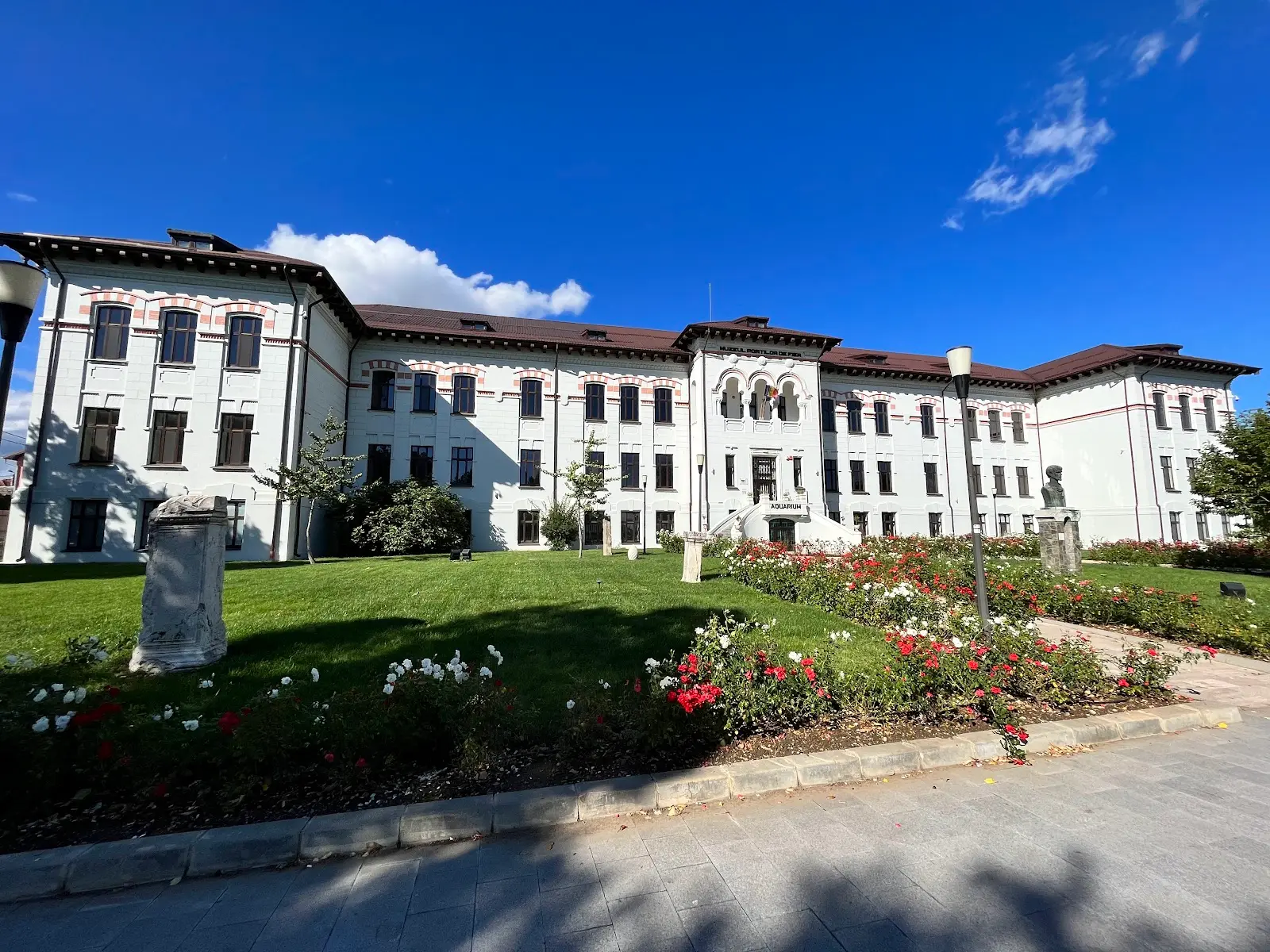
Drobeta-Turnu Severin is a compact city and, for once, a genuinely walkable one: almost everything worth seeing is strung along a few hundred metres between the centre and the Danube. That means you can visit it properly, without rushing, in two days. Here is the order that works best.
1. The Iron Gates Region Museum
Start at the Iron Gates Region Museum, not because it is the most spectacular sight but because it hands you the key to all the others. It is a complete regional museum with several departments under one roof, right beside the river and a few steps from the Roman site.
What not to miss:
- The history and archaeology section, built around the finds from Drobeta: inscriptions, military equipment, everyday objects and a reconstruction of the Roman bridge. Afterwards, the ruins on the bank suddenly make sense.
- The ethnography section, covering village life in Mehedinți and along the Danube narrows — textiles, costumes, woodwork, fishing gear.
- The natural sciences section, devoted to the fauna and geology of the gorge.
- The Danube fish aquarium, the surprise of the visit. Catfish, carp, pike, asp, sturgeon: the river's own species, alive, metres from the river itself. If you are travelling with children, this is where you will spend the most time.
Give it at least two hours. It earns them.
2. Trajan's Bridge and the Roman fort
Step out of the museum and walk straight to Trajan's Bridge. This is what most travellers actually come for, and the reason the city appears in the history of Europe.
The bridge was raised in the early 2nd century AD to the design of Apollodorus of Damascus, for Trajan's Dacian campaigns — one of the most ambitious structures of antiquity and, for its day, a near-impossible bet: massive stone piers driven into Europe's widest river, with a timber superstructure above.
What you see today:
- The pier on the Romanian bank, a block of Roman masonry worn by two thousand years of water, with its counterpart visible across the river on the Serbian side.
- The surrounding site of the Drobeta fort, with curtain walls, tower bases, gates and the excavated Roman baths. Here you grasp that the bridge was not an isolated work but the head of a military system.
Do not expect standing arches, and do not rush the visit. The value of the place lies in what it represents, not in how much survives.
3. The medieval fortress of Severin
A short walk away, in a park open to the water, stands the medieval fortress of Severin — the same strategic threshold, a thousand years later.
Raised in the 13th century, the fortress was the centre of the Banate of Severin, a frontier march disputed in turn by the Hungarian kingdom, Wallachia and the Ottoman Empire. What remains are walls, tower bases and the outlines of courtyards, among the trees.
It is a modest ruin in scale, but the visit makes most sense immediately after the Roman site: you see the same spot used by two empires and several kingdoms for exactly the same reason — control of the Danube crossing.
4. The Water Castle and the city centre
The Water Castle is Severin's undisputed emblem, though it is neither a castle nor a fortress: it is the water tower built in the early 20th century to supply the city, with a brick silhouette and crenellated crown that looks more medieval than the actual fortress does.
It has been restored and fitted out as a viewpoint, with a terrace over the city, the park and the Danube; in the evening it is floodlit. Use it as a pretext for a walk through the centre laid out in the 19th century, with its wide boulevards, eclectic buildings and parks — including the riverside promenade, which is where the city lives out its evenings.
5. A day at the Iron Gates
The second day belongs to the river. Severin is the most convenient base for the most spectacular stretch of the European Danube, and the road upstream along the bank is one of the finest drives in Romania.
- The Iron Gates I dam — the hydroelectric scheme built jointly with the Serbian side, the work that raised the water, drowned rapids and islands and turned the river into a lake. The island of Ada Kaleh and its Turkish community went under with it; some of its inhabitants were resettled at Șimian, near the city.
- The Danube Cauldrons — the climax of the gorge, roughly an hour's drive away: the river squeezed between limestone walls, the face of Decebalus carved into the rock, Mraconia Monastery at the waterline and the Tabula Traiana on the far bank. The best version is the combination: the drive plus a boat trip.
If you have a third day, Băile Herculane and the Cerna valley join naturally onto the same route.
6. An evening on the Danube
Severin has a good habit inherited from its days as a port: the day ends on the riverbank. The promenade that follows the water, between the parks and the landing stage, is where the town comes out to walk once the heat drops, and at sunset the light falling across the river and the Serbian bank opposite does work that no daytime sight can match.
A few things worth building in:
- A boat trip or a short cruise upstream if the weather is kind — the river seen from the water is a different river.
- The cooking of Mehedinți, with its southern and Banat influences: Danube fish, vegetables, peppers, dishes cooked in a cauldron. This is wine country too, on the hills behind the city.
- The central parks, which are the difference between a town you pass through and one where you are happy to spend an evening.
How to split your time
- One day only: the museum in the morning, the bridge and fort at midday, the fortress and Water Castle in the afternoon, the promenade at sunset.
- Two days: day one in the city, day two at the dam and the Cauldrons.
- Three days: add Herculane, or the Mehedinți Plateau with its caves and gorges.
With children the order shifts slightly: aquarium first, then the ruins, and save the Water Castle for last as a reward with a view.
For the full context of the city — history, climate, transport, where to stay — read our guide to Drobeta-Turnu Severin as well.
Plan your trip
Stays nearby
Stays in Romania
Experiences
Tours & activities
Guided tours, day trips and hand-picked experiences via GetYourGuide — free cancellation on most.
See all experiencesGetting to Romania
Flights, transfer & car
Fly into Romania
Compare fares to Bucharest Otopeni (OTP) and regional airports — Cluj, Sibiu, Iași, Timișoara.
Airport transfer
Private, fixed-price door-to-door transfer — driver waiting from the moment you land.
Rent a car — see the real Romania
A rental car is the key to Romania: the Transfăgărășan, the painted monasteries of Bucovina, mountain roads and the villages of Maramureș that no train reaches.
Find a car











