Things to Do in Suceava and Bukovina: the Best Sights
Suceava, the old capital of Moldavia, is the gateway to Bukovina and its painted monasteries. From the Princely Citadel to the Voroneț blue, the black pottery of Marginea and the Prislop Pass into Maramureș — here is what to see.
Few corners of Europe hide as much beauty behind so little fame as Bukovina, the wooded, hilly northeast of Romania. Its unofficial capital is Suceava — for nearly two centuries the seat of the Moldavian princes and now the natural base for exploring one of the continent's most extraordinary artistic treasures: a cluster of monasteries whose exterior walls are painted, top to bottom, with frescoes that have survived five hundred winters in the open air. You come for the monasteries, but you stay for the whole world around them — the fortresses, the folk crafts, the rolling farmland and the mountain passes that lead deeper into old Romania.
Here is how to spend your time in and around Suceava.
The Princely Citadel (Cetatea de Scaun)
Start in the city itself, on the hill above the old center, where the Princely Citadel — Cetatea de Scaun — has watched over Suceava since the 14th century. This was the fortress of the Moldavian princes, most famously Stephen the Great, who reinforced it against the Ottomans and never lost it in battle. Restored and thoughtfully presented, the citadel today lets you walk its thick ramparts, cross the reconstructed bridge, and look out over the city and the Bukovina hills beyond. Costumed figures and reconstructed interiors bring the medieval court to life, making it one of the most family-friendly stops in the region and the clearest introduction to why Suceava mattered so much.
The Bukovina Village Museum and St John the New Monastery
Below the citadel spreads the Bukovina Village Museum, an open-air collection of wooden houses, workshops, a church and a mill gathered from villages across the region. It is a gentle, unhurried place to understand how ordinary Bukovinians lived — their carved gates, their painted rooms, their tools and looms.
Back in the center, the Monastery of St John the New (Sfântul Ioan cel Nou) holds the relics of the region's patron saint and a bell tower you can climb. Its painted church is a first taste of the frescoed style that reaches its peak in the monasteries out in the countryside. Together with the citadel, these sights make an easy full day without ever leaving the city.
The painted monasteries — the main draw
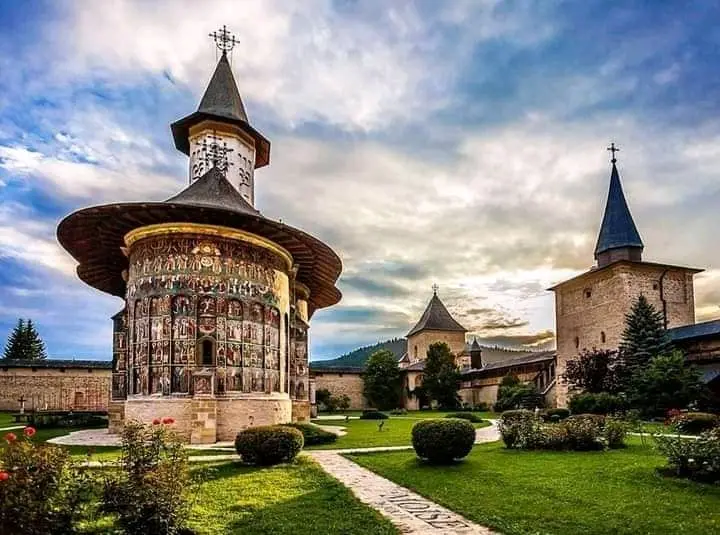
This is why the world comes to Bukovina. Scattered across the villages west of Suceava, a handful of 15th- and 16th-century monasteries carry frescoes not just inside but across their entire outer walls — a technique so rare and so well preserved that UNESCO added them to the World Heritage list. Each has its own color and character:
- Voroneț — the most famous, often called the Sistine Chapel of the East. Its Last Judgment fills the west wall, and the deep, luminous background known the world over as the Voroneț blue has never been fully reproduced by modern chemists.
- Sucevița — the largest and most fortified, ringed by high walls and towers, with a celebrated Ladder of Virtue fresco climbing toward heaven.
- Moldovița — set in a wide green valley, glowing in warm ochres and reds, its Siege of Constantinople among the most vivid scenes in Bukovina.
- Humor — smaller and more intimate, rich in reds, one of the earliest of the group.
- Arbore — quieter still, prized for its subtle greens and the delicacy of its detail.
You do not need to see all five, but Voroneț and one or two others together tell the whole story. The painted monasteries anchor our fuller Suceava and Bukovina guide, which lays out routes and the loop in more detail.
Crafts — painted eggs and the black pottery of Marginea
Bukovina is also one of Romania's living workshops. The region is famous for its painted eggs — ouă încondeiate — decorated with wax and dye in patterns handed down for generations; several village museums and family workshops let you watch the work and buy directly from the artisan.
Near the monasteries, the village of Marginea is known across the country for its black pottery, fired in a way that turns the clay a deep, smoky black and then burnished by hand to a soft shine. It is one of the last places in Europe where this ancient technique survives, and a piece bought at the kiln makes the most authentic souvenir you can carry home.
Day trips — deeper into Bukovina and over the Prislop Pass
With a car, Suceava opens onto some of the finest scenery in the country. Push west and north and the monastery loop keeps giving — quieter foundations, hermitages, and villages where haymaking still sets the rhythm of the day. The town of Gura Humorului and the resort valley around it make a good second base closer to Voroneț and Humor.
For the boldest day out, follow the road up and over the Prislop Pass, the high mountain crossing that links Bukovina to Maramureș — the neighboring land of wooden churches and carved gates. The drive alone, winding through alpine meadows, is one of the great Romanian road trips, and it stitches together two of the country's most traditional regions in a single unforgettable day.
Best for — and how long to stay
Suceava and Bukovina are best for travelers drawn to history, faith, folk art and slow, green landscapes rather than nightlife or beaches — it is a region for early risers, curious walkers and anyone moved by craftsmanship. Give the city itself a full day for the citadel, the village museum and St John the New. Then set aside two to three days for the monastery loop, which lets you take Voroneț, Sucevița, Moldovița, Humor and Marginea at a human pace, with time for the crafts and a valley picnic. Add a fourth day if you plan to cross the Prislop Pass into Maramureș. However long you stay, Bukovina rewards the unhurried — this is a place to linger, not to tick off.
Plan your trip
Stays nearby
Stays in Romania
Experiences
Tours & activities
Guided tours, day trips and hand-picked experiences via GetYourGuide — free cancellation on most.
See all experiencesGetting to Romania
Flights, transfer & car
Fly into Romania
Compare fares to Bucharest Otopeni (OTP) and regional airports — Cluj, Sibiu, Iași, Timișoara.
Airport transfer
Private, fixed-price door-to-door transfer — driver waiting from the moment you land.
Rent a car — see the real Romania
A rental car is the key to Romania: the Transfăgărășan, the painted monasteries of Bucovina, mountain roads and the villages of Maramureș that no train reaches.
Find a car