
What to see in Miercurea Ciuc and Harghita
Cetatea Mikó and the Székely Museum of Ciuc, the pilgrimage hill of Șumuleu Ciuc, Romania's only volcanic lake and the Mohoș bog beside it, Harghita-Mădăraș Peak, Székely baths and roadside mineral springs — the sights worth the drive, in the order that makes sense.
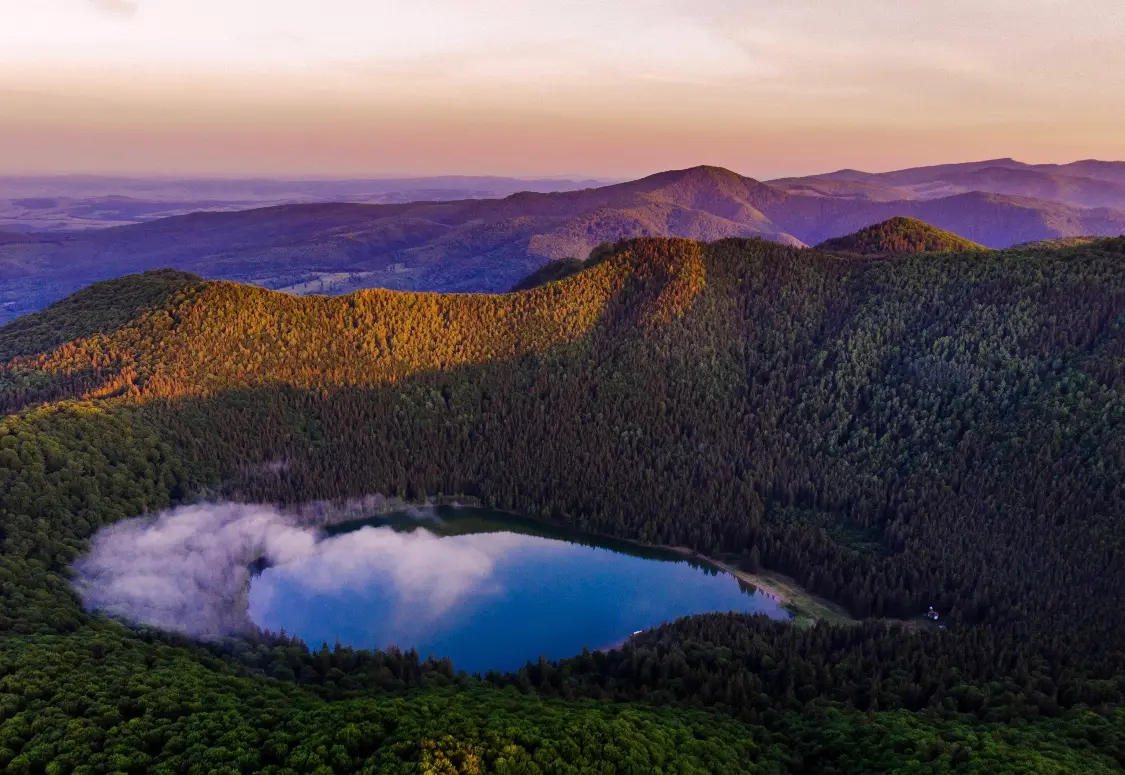
Harghita is one of the few counties in Romania where a single day can hold a volcanic crater, a peat bog with carnivorous plants and a Renaissance fortress. Miercurea Ciuc is the bridgehead — small, walkable, with two or three serious sights — and the rest is behind the wheel, on roads climbing through beech and spruce. Here is what deserves your time, in the order that makes sense.
Cetatea Mikó, the heart of town
Cetatea Mikó is the most important historic building in town: a 17th-century Renaissance fortification on a square plan, with bastions at its corners. There are no romantic turrets and no vampire legends — just clean military proportions and an inner courtyard where the noise of the town suddenly drops away.
Its location right in the centre is an advantage. You can give it an hour in the morning, before anything else, and leave with the context you need for the rest of the day.
The Székely Museum of Ciuc
Inside the fortress works the Székely Museum of Ciuc, the best place in the county to understand who the Székely are and how they lived. The collections cover crafts, painted furniture, pottery, textiles, old printed books and village life.
If this is your first time in Harghita, the museum earns its place before any hike: it changes the way you read the villages you will drive through afterwards.
The Roman Catholic church and the centre
The Roman Catholic church of Miercurea Ciuc is the stop that completes the centre. Catholicism here is part of the community's identity rather than one denomination among several — and the interior says that better than any explanation could.
Around it, the centre takes less than an hour on foot: the main square, a few streets of small shops with Hungarian signs, neighbourhood patisseries. It is not a spectacular old town, but it is authentic and has not been rebuilt for visitors.
Șumuleu Ciuc
Șumuleu Ciuc, on the hill at the edge of town, is the sight that gives Miercurea Ciuc its weight on the Central European map. The Franciscan monastery here is the most important Hungarian Catholic pilgrimage site in Transylvania, and the Pentecost pilgrimage gathers an immense crowd from across Transylvania, from Hungary and from the diaspora.
Come at any other time and you will find quiet, an avenue of tall trees, a Baroque church and a wide panorama over the Ciuc basin. Climb up towards evening — the light is at its best and the place is nearly empty.
Lacul Sfânta Ana
Lacul Sfânta Ana is the undisputed star of the region and the reason many people come at all: the only volcanic crater lake in Romania. It lies south of Miercurea Ciuc, above the spa resort of Băile Tușnad, in an almost perfectly round crater closed in by beech forest.
Its water comes almost entirely from rain and snow, so it is extremely poor in minerals — hence its clarity. You can walk the shore path all the way round, and marked trails climb to the crater rim for the view from above. In autumn, when the beeches turn, it is the most beautiful place in Harghita.
The area is protected, with regulated access and designated parking, so it is worth checking visiting conditions before you set out. The finest approach is not the most comfortable one: walking up from Băile Tușnad through the forest delivers the lake exactly as it should be seen — unannounced, after the last bend.
The Mohoș peat bog
In the neighbouring crater, a few minutes away, lies the Mohoș peat bog — a protected peatland formed in the massif's second crater, with pools of dark water, sphagnum moss and rare carnivorous plants.
It is visited only along the wooden boardwalk, with a guide, because peat is a fragile ecosystem that recovers at a glacial pace. It is nothing like the lake: not spectacular but strange — a landscape that seems transplanted from northern Scandinavia.
Harghita-Mădăraș Peak
West of town rises Harghita-Mădăraș Peak, the best-known mountain objective in the county. Trails start from the Harghita-Mădăraș area and climb through spruce forest to the open alpine ground, where in good weather you see the whole basin and the Ciuc ridge beyond.
In winter the area is snowshoe and ski-touring terrain. For routes, maps and the technical detail of hiking in the Harghita Mountains, the right place is munte.online — that is their territory.
Székely baths and mineral springs
Harghita is a county of springs. Beyond the well-known resorts, villages have their own Székely baths — small basins, sometimes wooden, fed with cold or gently warmed mineral water and used by locals for generations. These are not modern spas; they are village institutions, plain and charming.
On the roads between villages you will also find borcut springs — roadside sources of naturally sparkling mineral water where people turn up with canisters. Stop, taste, fill a bottle. It is about as local as an experience gets here.
The villages of the basin
Between Miercurea Ciuc and the mountains lie Székely villages with wide carved wooden gates, whitewashed Catholic churches and graveyards of carved crosses. They hold no sights to tick off, but they are worth the drive for the atmosphere, the architecture and the people still keeping crafts alive.
The best way to see them is without a plan: take a side road climbing between the hills, stop wherever you spot a handsome gate or an open church, and come back by a different route. Many villages still keep their patron-saint feasts and Catholic celebrations, with processions, costumes and a brass band — if you stumble into one, abandon the rest of the itinerary and stay.
An evening at the hockey
Miercurea Ciuc is the capital of ice hockey in Romania, and an evening at a match is one of the most honest local experiences available: full stands, songs in Hungarian, children in club scarves and an intensity you would not associate with a town this size.
It is not a tourist attraction and it appears in no brochure, but if you come in the cold season it is worth checking the fixture list. You will understand the town better from one period of play than from half a museum.
How to string it together
- One day — Cetatea Mikó, the Székely Museum of Ciuc, the Roman Catholic church, then Șumuleu Ciuc.
- Two days — add Lacul Sfânta Ana and the Mohoș bog, with a stop in Băile Tușnad.
- Three days — add Harghita-Mădăraș and a Székely bath out in a village.
For context, practical advice and transport, read the complete guide to Miercurea Ciuc. For accommodation, area by area, see where to stay in Miercurea Ciuc and Harghita.
Field notes
- A car makes the difference. The lake, the bog and the peaks do not connect well by public transport.
- Bring hiking shoes even for the stroll around the lake. The path is earth and turns slippery after rain.
- Weather changes fast in the basin and on the ridge. Carry a rain shell, always.
- Respect protected-area rules: stay on the path, pick nothing, and leave the drone packed where flying is banned.
- Check access to the bog and the lake before you set out, as this is a protected area and the rules can shift from season to season.
Plan your trip
Stays nearby
Stays in Romania
Experiences
Tours & activities
Guided tours, day trips and hand-picked experiences via GetYourGuide — free cancellation on most.
See all experiencesGetting to Romania
Flights, transfer & car
Fly into Romania
Compare fares to Bucharest Otopeni (OTP) and regional airports — Cluj, Sibiu, Iași, Timișoara.
Airport transfer
Private, fixed-price door-to-door transfer — driver waiting from the moment you land.
Rent a car — see the real Romania
A rental car is the key to Romania: the Transfăgărășan, the painted monasteries of Bucovina, mountain roads and the villages of Maramureș that no train reaches.
Find a car











