
What to see in Arad: attractions & experiences
The sights worth your time in Arad: the Cultural Palace, the facades of Bulevardul Revoluției, the theatre, the cathedral, the Water Tower, the Vauban fortress, Reconciliation Park, Ceala Forest and the Miniș cellars.
Arad is best seen on foot, with your head up. The big landmarks line up along a single boulevard, and the rest — the fortress, the cathedral, the river — fall naturally into a loop that drops down to the Mureș. Below are the sights worth your time, in the order in which they link up best.
The Cultural Palace
If Arad has one signature building, this is it. The Cultural Palace gathers the city's philharmonic and its museum under one roof, and its architecture is exactly the kind of blend you find in Central European cities of the early twentieth century: classical elements, eclectic accents, and a monumentality visible from the far end of the square.
Look at it from a distance first, for the proportions, then up close, for the detail. If a philharmonic concert falls during your visit, you have the best possible excuse to see the interior in the context it was built for.
- View the facade from two or three different points in the square.
- Check the museum and philharmonic schedules for the day you visit.
- Photographs work best when light falls directly on the facade.
Bulevardul Revoluției
Not a sight but the city's spine — and one of the handsomest urban avenues in Romania. Eclectic palaces, Secession facades and neoclassical fronts succeed one another on both sides, with wrought-iron balconies, floral ornament and finely worked window surrounds.
The proper walk takes an hour and goes out and back, one side at a time. The best details sit at upper-storey level, where nobody looks.
- Walk each pavement once: the two fronts look completely different.
- Hunt for detail on the cornices and above the windows.
- Stop for a coffee on a terrace — it's part of the experience.
The Administrative Palace and the city hall tower
The Administrative Palace is the seat of the city hall and, thanks to its tower, the simplest orientation point downtown. The massive block and the tower's vertical form the classic pairing of any photograph of Arad.
- The best view of the building is from the opposite side of the boulevard.
- The tower works as a beacon: if you can see it, you know where the centre is.
The Ioan Slavici Classic Theatre
The Ioan Slavici Classic Theatre is the city's long-established performing institution, and the building that houses it closes the central square with a front worthy of a regional capital. Even if you don't attend a performance, its position in the square explains a great deal about how the centre of Arad was conceived.
- Check the programme: an evening at the theatre is the best way to end a day in Arad.
- The square in front of the theatre is the city's natural meeting point.
Holy Trinity Orthodox Cathedral
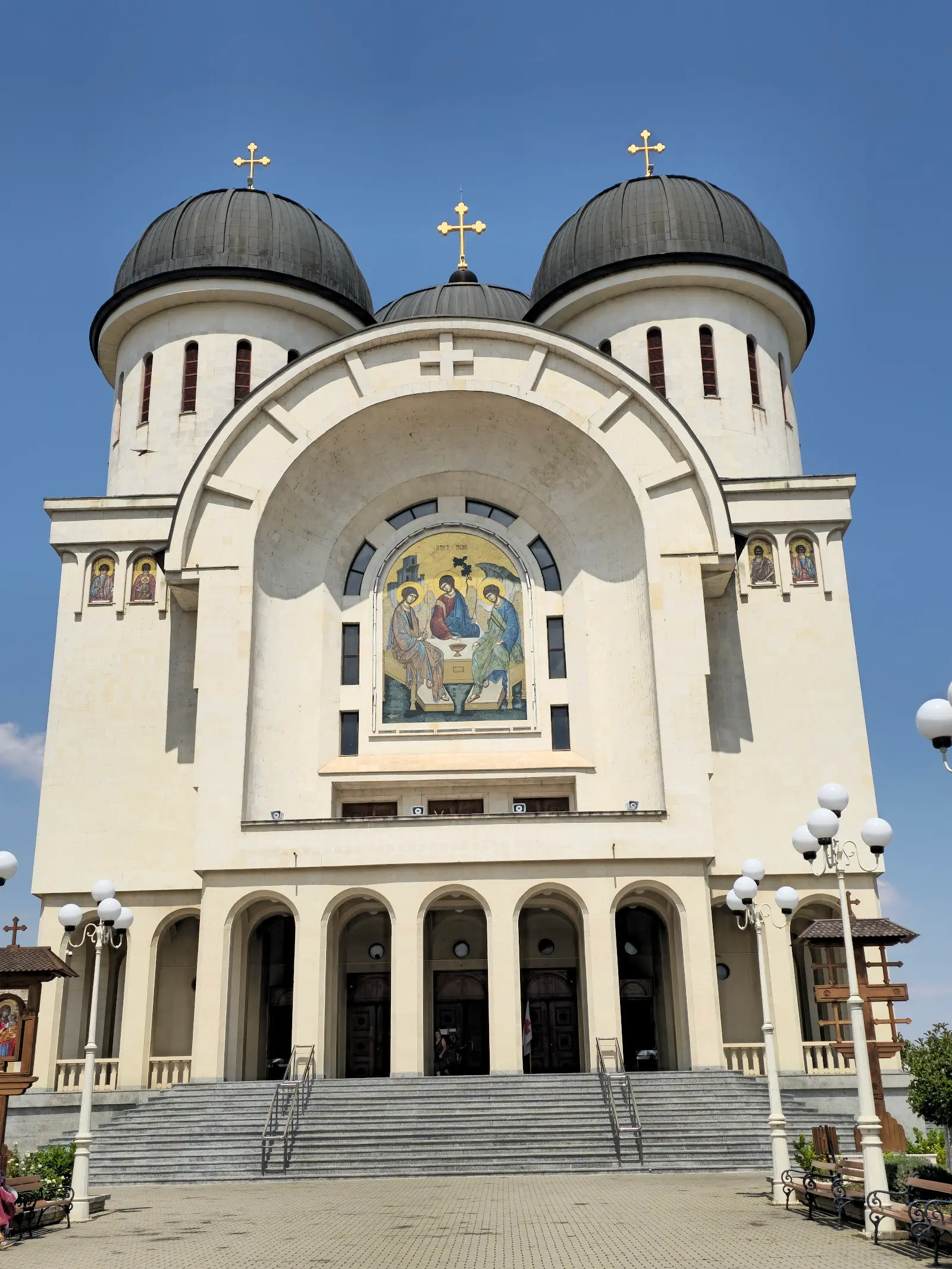
The Holy Trinity Orthodox Cathedral is the modern city's major religious landmark — a large structure, visible from a distance, deliberately contrasting with the civic architecture of the boulevard.
- Dress modestly and keep quiet; this is an active place of worship.
- It fits neatly into the route that descends from the boulevard to the river.
The Water Tower
The Water Tower is one of the city's surprises: industrial architecture from another era, a massive brick silhouette that today looks better than many of its modern neighbours. For anyone interested in industrial heritage or photography, it's a short stop with a high return.
- Shoot it from below to catch the full vertical.
- It takes minutes to see; attach it to a longer walk.
The Arad Fortress
The Arad Fortress is a Vauban-style bastion fortification, built on the military engineering principles that shaped eighteenth-century European defences: star-shaped geometry, sharp bastions, low and massive walls designed for the artillery age.
It is an impressive structure in plan, set beside the Mureș, and one of the most interesting of its kind in Romania. Access is restricted, but the silhouette and the siting read clearly from outside and from the riverside.
- Check the access arrangements before you go.
- Even seen only from outside, the geometry of the bastions is worth the detour.
Reconciliation Park and the Statue of Liberty
Reconciliation Park is the public space that shelters the Statue of Liberty, one of the most discussed monuments in the city. It's a short stop with a great deal of historical context — a place where Arad puts its multi-ethnic past on the table.
- Read the explanatory plaques; without them, half the meaning is lost.
- Combine it with the walk towards the fortress and the river.
The squares and the evening walk
Arad has a good habit inherited from Central European city culture: in the evening, people come out. The downtown squares and the pedestrian streets around the boulevard fill up as the sun drops across the facades and the temperature turns bearable, even in July.
This isn't a sight you tick off, it's the right way to end the day. Lit facades look nothing like they do at noon, and the ornamental detail stands out far better in warm, low light.
- The best hour for photographs is just before sunset.
- Terraces fill up at weekends; come early or book.
- Pair the walk with a performance or concert if the programme allows.
Ceala Forest and the Mureș channels
Beyond the centre, Arad has an excellent green plan. Ceala Forest is a floodplain woodland set between the branches of the Mureș, with paths, shade and water — where locals go when the city heats up.
- Ideal for cycling, running, or a long walk with no sights attached.
- In summer, spend midday here; downtown is simply too hot.
- Bring water, and a blanket if you plan to sit on the grass.
The Arad wine region: Miniș and the cellars
A short distance from the city begins the Arad wine region, with its historic heart at Miniș — one of the oldest winegrowing areas in Romania. These hills are the reason to stay an extra night.
For a visit with a tasting, two well-known names are Balla Géza Winery and Wine Princess.
- Book in advance; cellars work by reservation.
- Go with a driver who isn't tasting, or on an organised trip.
- In autumn, during harvest, the hills are at their best.
Picked by theme
If you only have one day
- Bulevardul Revoluției, both sides
- The Cultural Palace and the Administrative Palace
- The Ioan Slavici Classic Theatre
- A descent to the cathedral and Reconciliation Park
For architecture lovers
- The Secession and eclectic facades of the boulevard
- The Cultural Palace, close up and from afar
- The Water Tower, for industrial heritage
- The Arad Fortress, for Vauban military architecture
With children
- Ceala Forest, for space and shade
- The banks of the Mureș, for a bike ride
- The downtown parks, between two sights
For a second day
- The Arad wine region and a cellar around Miniș
- The Mureș channels and the floodplain forest
- A performance at the theatre in the evening
For context, orientation and a full plan, see the Complete guide to Arad, and for choosing a neighbourhood, Where to stay in Arad.
Plan your trip
Stays nearby
Stays in Romania
Experiences
Tours & activities
Guided tours, day trips and hand-picked experiences via GetYourGuide — free cancellation on most.
See all experiencesGetting to Romania
Flights, transfer & car
Fly into Romania
Compare fares to Bucharest Otopeni (OTP) and regional airports — Cluj, Sibiu, Iași, Timișoara.
Airport transfer
Private, fixed-price door-to-door transfer — driver waiting from the moment you land.
Rent a car — see the real Romania
A rental car is the key to Romania: the Transfăgărășan, the painted monasteries of Bucovina, mountain roads and the villages of Maramureș that no train reaches.
Find a car











