Things to Do in Timișoara: the Best Sights & Experiences
Baroque squares, restored Secession facades, the memory of the 1989 Revolution and the Bega Canal — a step-by-step guide to the best things to do in Timișoara, European Capital of Culture 2023.
Timișoara wears its nickname well. Locals call it Romania's „Little Vienna", and once you stand on the pastel-fronted squares of the old town, the comparison stops feeling like local pride and starts feeling accurate. This was the first city in continental Europe lit by electric street lamps, the first with a horse-drawn tram, and the place where the 1989 Revolution ignited and toppled a dictatorship. In 2023 it wore the crown of European Capital of Culture, and the restoration work that came with it left the historic core looking better than it has in a century.
What makes Timișoara so rewarding is that everything worth seeing sits within an easy walk. Three grand squares line up almost in a row, connected by pedestrian streets and shaded promenades. Here is how to spend your time.
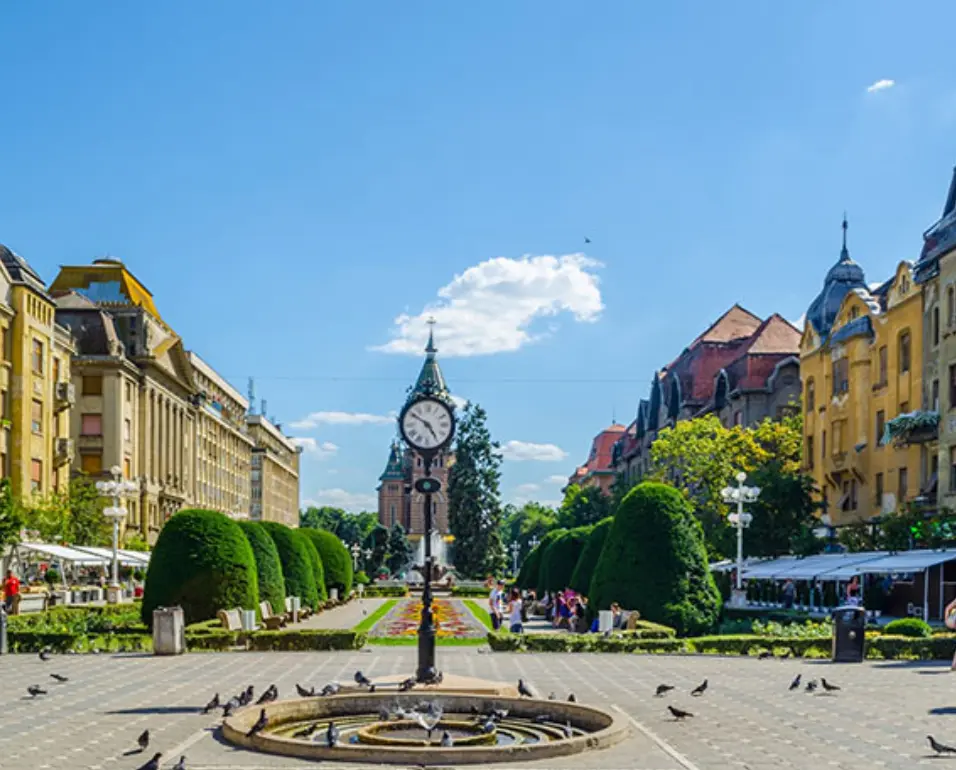
Victory Square (Piața Victoriei)
Start where the city beats loudest. Victory Square is a long, elegant esplanade framed by two monuments that tell you exactly who Timișoara is. At one end stands the Romanian National Opera and National Theatre, its facade a favourite backdrop for evening strolls. At the other rises the Metropolitan Orthodox Cathedral, a soaring interwar landmark with a distinctive tiled roof and one of the tallest church towers in the country.
Between them runs the promenade where, in December 1989, crowds gathered and chanted against the regime. This is the ground zero of the Revolution, and plaques and memorials along the square mark it. Come for a coffee at one of the terraces, look up at the cathedral, and you are standing in the exact spot where modern Romania began.
Union Square (Piața Unirii)
A few minutes north, Union Square is the baroque heart of the city and, for many visitors, the single most beautiful space in Timișoara. Ringed by candy-coloured 18th-century facades, it feels genuinely Central European — closer to Vienna or Budapest than to anywhere else in Romania.
Two cathedrals face each other across the cobbles: the Roman Catholic Dome, a grand baroque church, and the Serbian Orthodox Cathedral, a reminder of the many peoples — Germans, Serbs, Hungarians, Romanians, Jews — who built this city together. In the centre stands the plague-column monument and a baroque fountain. Sit on the terrace of a café here in the late afternoon and you will understand why people fall for Timișoara.
Liberty Square & the Secession architecture
Linking the two great squares is Liberty Square (Piața Libertății), smaller and more intimate, historically the city's military and civic core. But the real reward of wandering these streets is the architecture itself.
Timișoara holds one of the richest collections of Secession — Central European Art Nouveau — buildings anywhere. Look up as you walk and you will see sinuous floral motifs, decorative tilework, curved balconies and pastel plaster restored to their original glory. The restoration campaign for the Capital of Culture year brought dozens of these facades back to life. Streets like the ones around Piața Unirii and along the pedestrian corridor reward slow, unhurried walking with a camera.
The memory of the 1989 Revolution
No visit to Timișoara is complete without understanding what happened here. This is the city where the Romanian Revolution began. In December 1989, a stand around a dissident pastor grew into mass protests, met with deadly force, that within days spread to Bucharest and ended the Ceaușescu regime.
The Memorial of the Revolution (Memorialul Revoluției) tells this story with documents, photographs, film and personal testimony. It is a moving, sobering counterpoint to the pretty squares — and it explains the pride you feel everywhere in the city. Timișoara calls itself the first free city of Romania, and it earned the title.
The Bega Canal & the historic quarters
The Bega Canal loops through the city and gives Timișoara its „Little Vienna" waterfront. Tree-lined promenades and parks follow the water — the Roses Park, the Central Park, the Botanical Park — perfect for a slow bike ride or a riverside walk. In warmer months, small vaporetto-style boats run along the canal, a relaxed way to see the city from the water.
Beyond the centre, two historic districts reward exploration. Fabric was the old industrial and workers' quarter, full of Secession and eclectic buildings and a growing café scene. Iosefin, near the river and the old railway station, is another handsomely faded neighbourhood slowly being rediscovered. Both feel local and unhurried, away from the main squares.
Museums & culture
For a rainy afternoon or a deeper dive, Timișoara delivers. The Timișoara Art Museum, housed in the baroque palace on Union Square, holds a strong collection including works by Romanian modernists. The Museum of the Consequences of Communism and the Memorial of the Revolution together give the historical and political context.
The city's cultural calendar is busy year-round — a legacy of the Capital of Culture year — with festivals, concerts at the Opera, and contemporary art in restored industrial spaces. Check what is on when you visit; there is almost always something.
Day trips from Timișoara
Timișoara is the gateway to the Banat, and a couple of days here open up some of Romania's least-touristed and most rewarding countryside.
- Recaș wine country — barely half an hour east, the vineyards around Recaș are among Romania's best-known, an easy and delicious half-day of tasting.
- The Banat mountains — south of the city, the Semenic and Anina ranges hide gorges, karst caves and the Nera and Cheile Nerei-Beușnița national park, all wild and quiet.
- The Bigăr waterfall — a couple of hours away, this moss-draped cascade spilling over a rounded rock became one of Romania's most photographed natural sights.
Best for, and how many days
Timișoara is best for travellers who want a beautiful, walkable Central European city without the crowds of Prague or Vienna — for architecture lovers, for anyone drawn to modern European history, and for a relaxed café-and-squares kind of break.
Give it two full days to see the squares, the museums and the canal at a proper pace. Add a third for a day trip into the Banat or the Recaș vineyards. Pair it with our wider Timișoara guide and our writing on the Banat to build a longer western-Romania itinerary — this is one of the country's most underrated corners, and it rewards the time you give it.
Plan your trip
Stays nearby
Stays in Romania
Experiences
Tours & activities
Guided tours, day trips and hand-picked experiences via GetYourGuide — free cancellation on most.
See all experiencesGetting to Romania
Flights, transfer & car
Fly into Romania
Compare fares to Bucharest Otopeni (OTP) and regional airports — Cluj, Sibiu, Iași, Timișoara.
Airport transfer
Private, fixed-price door-to-door transfer — driver waiting from the moment you land.
Rent a car — see the real Romania
A rental car is the key to Romania: the Transfăgărășan, the painted monasteries of Bucovina, mountain roads and the villages of Maramureș that no train reaches.
Find a car