Things to Do in Sighișoara: the Best Sights & Experiences
A complete guide to Transylvania's fairy-tale citadel: the Clock Tower, the guild towers, the Covered Staircase, Vlad Dracul's house and the best day trips nearby.
Few places in Europe carry you back in time as effortlessly as Sighișoara. This medieval citadel on a hill in the heart of Transylvania — crowned by a clock tower that has kept watch for centuries, ringed by guild towers, its burgher houses painted ochre, red and green — is the only continuously inhabited fortified town in Eastern Europe, and one of the few living citadels left in the world, where people still sip coffee beneath 700-year-old stone arches. A UNESCO World Heritage Site, the Saxon citadel is best explored slowly on foot, over its time-worn cobbles, in a relaxed half day or a full day if you add the countryside around it.
Here are the best things to do in the fairy-tale jewel of Transylvania.
The Clock Tower — the heart of the citadel
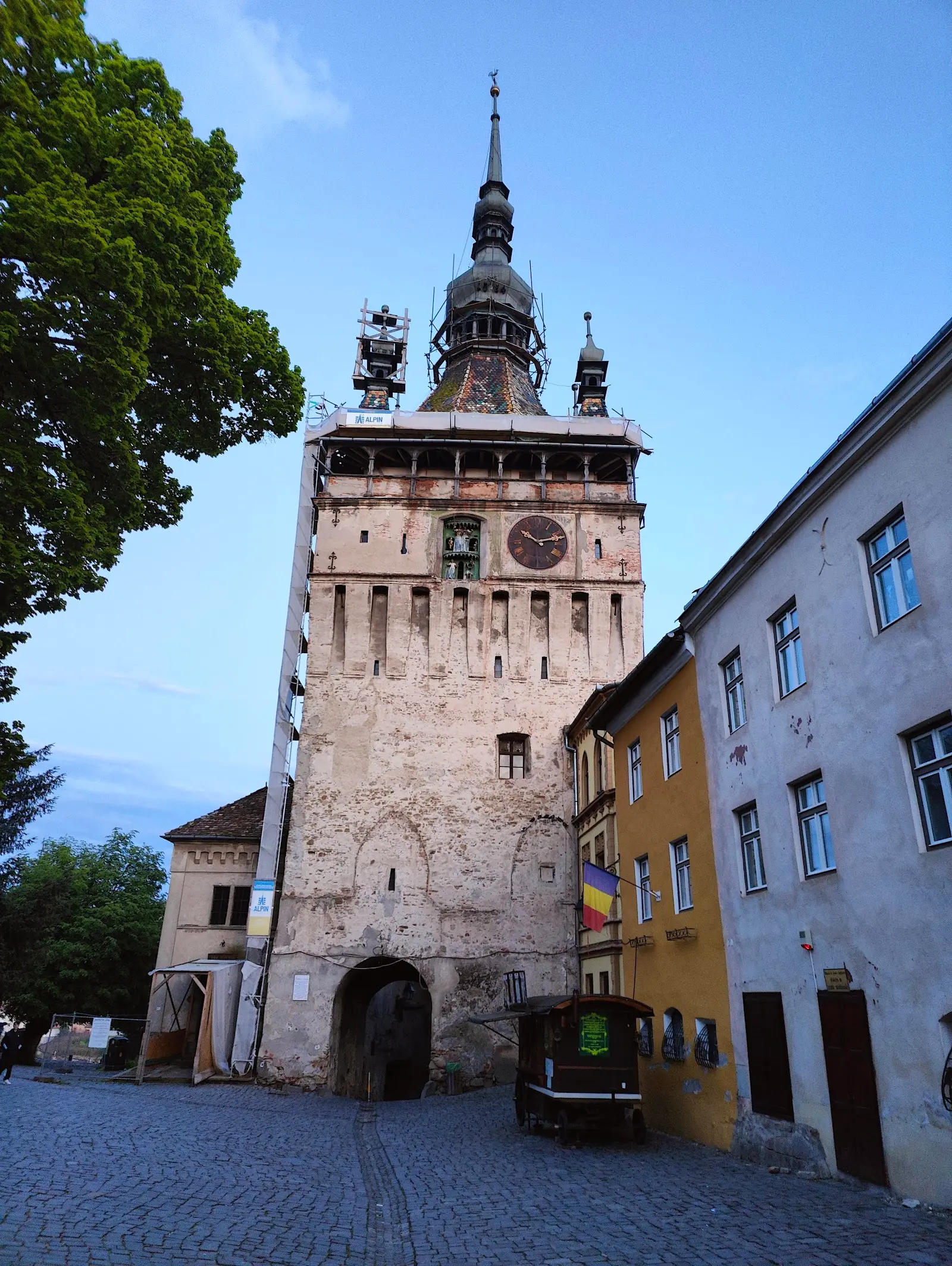
The absolute symbol of Sighișoara, the Clock Tower (Turnul cu Ceas, the former Council Tower) guards the main entrance to the citadel from a height of more than 60 metres. Built in the 14th century, it long served as the town hall. Its most enchanting detail is the set of clock figures: two groups of carved wooden characters — among them the goddesses of the days of the week and the figures that mark day and night — rotate at each change, a tiny ceremony visitors gather below to watch.
Inside, the tower now houses the History Museum, laid out over several floors with guild collections, an old apothecary, weapons and medieval objects. Climb all the way to the panoramic gallery at the top: from there unfolds one of the most beautiful views in Transylvania, over the red roofs, the defensive towers and the surrounding hills.
The guild towers & the citadel walls
Sighișoara was once defended by fourteen towers, each built and maintained by a craftsmen's guild. Nine survive, and walking the line of the defensive walls carries you from one to the next like a living map of the Middle Ages.
Don't miss:
- The Tailors' Tower — the second gateway into the citadel, with a vaulted passage you walk through into the square.
- The Tinsmiths' Tower — one of the best preserved, with its distinctive polygonal shape.
- The Blacksmiths', Butchers' and Cobblers' towers — each carrying the story of the guild that raised it.
The towers' names tell the town's economic history on their own: here lived and worked Saxon tailors, goldsmiths, tinsmiths and cobblers whose guilds made Sighișoara a prosperous trading centre.
The Covered Staircase & the Church on the Hill
From the Citadel Square begins one of the most atmospheric climbs in Romania: the Covered Staircase (Scara Acoperită, the Scholars' Stairs), a wooden tunnel of 175 steps built in the 17th century to shelter pupils and parishioners from rain and snow on their way to church. The ascent through the half-dark, with light filtering between the planks, feels like something out of a storybook.
At the top waits the Church on the Hill, a Gothic building from the 14th century with medieval frescoes and a rare crypt beneath the altar. Beside it lies the old Saxon (Evangelical) cemetery, shaded by fir trees, where German-speaking families have rested for centuries — a quiet place of gravestones carved in German and sweeping views over the whole citadel.
Vlad Dracul's house & the Dracula link
In the heart of the citadel, a yellow house with a coat of arms above the door bears the name Casa Vlad Dracul. Vlad II Dracul, father of Vlad the Impaler, is said to have lived here, and tradition holds that the future ruler was born in this very building, around 1431.
It's worth separating myth from history. Vlad the Impaler was a real prince of Wallachia, feared for the cruelty of his punishments — but Bram Stoker's 1897 novel Dracula is pure Gothic fiction, and the vampire in the book has no direct historical link to Sighișoara. Even so, the shared name makes the town a key stop for anyone fascinated by the Dracula legend. Today the building houses a restaurant and a small themed exhibition. Take the legend with a smile and enjoy the atmosphere.
The Citadel Square & wandering the cobbled lanes
Sighișoara's real magic reveals itself when you put the guidebook away and wander the lanes. The Citadel Square (Piața Cetății), once the site of markets and executions, is now the centre of life, framed by colourful burgher houses from the 16th to 18th centuries, with narrow windows and carved doorways.
Lose yourself on the little streets that climb and descend, stop at a café terrace beneath the walls, and admire the details: a wrought-iron gate, a guild crest, a painted shop sign. If you come in summer, during the Medieval Festival, the town transforms completely — knights, craftsmen, early music and sword fights fill the square in one of the most spectacular celebrations in Transylvania.
Day trips from Sighișoara
Sighișoara is also an excellent base for discovering the Saxon Transylvania around it:
- The Saxon fortified-church villages — a short drive away lie Biertan, with its imposing UNESCO fortified church and famous "divorce tower", and Viscri, the village with the little white church made famous partly through King Charles III. These are the most authentic corners of the old Saxon world.
- Brașov — about an hour and a half to the south, the town at the foot of Mount Tâmpa, with its Council Square and the Black Church.
- Sibiu — a former European Capital of Culture, with its elegant squares and the "eyes" peering from the rooftops.
You can easily combine Sighișoara, Biertan and Viscri into a single day of touring through the Transylvanian hills.
Best for — and how long to stay
Sighișoara is ideal for romantic couples, families with children who love tales of knights, photography lovers and anyone seeking a break from the 21st century. It's a small, intimate town, explored calmly on foot.
For the citadel itself, half a day is enough to see the Clock Tower, the guild towers, the Covered Staircase and the Church on the Hill. Set aside a full day if you want to linger in the museums, savour a lunch in the square and add a trip to Biertan or Viscri. However you choose, Sighișoara will remain one of the most beautiful travel memories you take home from Romania.
Plan your trip
Stays nearby
Stays in Romania
Experiences
Tours & activities
Guided tours, day trips and hand-picked experiences via GetYourGuide — free cancellation on most.
See all experiencesGetting to Romania
Flights, transfer & car
Fly into Romania
Compare fares to Bucharest Otopeni (OTP) and regional airports — Cluj, Sibiu, Iași, Timișoara.
Airport transfer
Private, fixed-price door-to-door transfer — driver waiting from the moment you land.
Rent a car — see the real Romania
A rental car is the key to Romania: the Transfăgărășan, the painted monasteries of Bucovina, mountain roads and the villages of Maramureș that no train reaches.
Find a car